Showing posts with label Ana Parker Goodwin. Show all posts

Wednesday, April 1, 2015

The New Research into Memory: Do we really remember events as they happened?


My book Justice Forbidden: What is memory all about?
Does our brain really remember events as they happened?
 

Recently I read the quote, "We are now in the age of brain and memory research." It's about time I said to myself. What we knew about these topics until a few years ago was mere speculation and could have fit into a shoebox.

Have you ever wondered whether your memories of the past are accurate? I have. And as a psychotherapist in a private practice working with many clients who had been diagnosed as having Post Traumatic Stress Disorder, I often questioned and so did they. I had no real answers for them at the time.

And so after my retirement, when I unexpectedly changed my course in life and began to write mysteries, I decided to explore this question and add my own feverish imagination to the plot. Justice Forbidden is a murder mystery/thriller of a psychologist who is being sued for creating memories in a client about previous abuse that she now says never occurred. Were Kera's memories real? Is she lying to get money? Or did Dr. Faythe Bradington implant those memories as Kera now claims? And is that even possible? What does the present research of the brain and how it constructs memories now say?

Did you know that in Freud's day it was thought that the brain worked like a camera? It took an accurate movie of an event and stored it unchanged forever. That meant there was only one true story and all your memories were accurate. Later psychologists realized that each person had his or her own perception of what happened but they believed this perception never changed. Psychologists thought that some people could repress difficult memories and then could retrieve them later. More recently some researchers in psychology conjectured that memory was not completely accurate and that there was no evidence that memories could be repressed and then later remembered. As a matter of fact, they thought that all repressed memories that were later remembered had been merely made up by someone with an overactive imagination or had been programmed into the brain by an authority figure like a psychotherapist. Thus the False Memory Syndrome was born. You have probably heard of it. The topic used to be all the rage and several fiction books included false memories.

In the meantime the question of memory was still not answered and most of us had no idea what memory was really all about. Now that we have Functional Magnetic Resonance Imaging, researchers can actually see what is happening in the brain as it works and forms thoughts, emotions, and memories. So what is true? Of course the whole truth is still unknown and may take years of research to pin down. But we gradually know more and more.

Yes, first of all, complete false memories can be created by the brain without the person knowing. What is even more interesting is that each time you remember an incident the brain reconstitutes it in a somewhat different way. A new memory is born. The old memory is gone and can never be retrieved exactly as it originally occurred.

So what does that mean for what we call truth and nothing but the truth? Is anyone remembering the "truth" of an event as it really happened? Probably not. That may at least partly account for the fact that you and your sister or brother don't remember the same incident in the same way. Or maybe you remember something she says never happened. Who is right? Possibly neither of you. And what does that mean for the accuracy of eye witnesses? And what about autobiographies and true stories? We may have to call everything we remember just that. "My memories of what I think happened. They are probably based on an actual event."

Researchers now know how we can repress and forget difficult memories, but they are still not sure repressed memories can be recovered. One researcher states he believes he has found the path the brain takes to retrieve them.

Recently the military designated millions of dollars to test drugs that will actually erase PTSD memories. However, actual use of them is still years away. Will the drug eliminate only the memories a person wants eliminated or will they clear out all memories? Or are the memories repressed deeper in the brain?  Only time will tell. Because of the horrendous effects and memories of war and abuse, the researchers already have lines of volunteers waiting to become subjects when human trials begin.

Stay tuned for the next chapter in this puzzling but critical issue. Oh, and in the meantime read my book Justice Forbidden for an exciting and stimulating, can't put down read. It is on www.Amazon.com as an e-book for only $2.99. I am writing the sequel at present.
Check out my website for my writings www.anaparkergoodwin.com

Wednesday, February 25, 2015

When Late Book Marketing is Better than Early


When Late Book Marketing is Better than Early
It seems that every time I read an article on book marketing, marketers warn that the author or publishing company should be out there selling their books now. Don't wait until it is published. That's too late.  Well, I'm sure that can work for some people. But not in some cases.

But wait a minute. Let me tell you of an experience I had.

Some months before I published one of my books with a small publisher, I was reassured that the book would be out at the end of September in time for a conference I was speaking at. Then in November I was attending another conference. Perfect, I thought. I could sell dozens of books and sign them at the same time. So although I am very familiar with human nature and my lack of control over other peoples actions, I trusted what I was told. Besides, everything I was reading had confirmed that earlier marketing was better.

So about a month prior to the release I flooded the conference and e-mail lists with an exciting  summary and a few excellent reviews of my psychological thriller, Justice Forbidden.  People were excited about the book. The beginning of September rolled around and I asked the publisher for the exact date of release. "We're trying very hard to get it out for the September conference," was the reply.

Well, you've probably guessed it. The September conference came and went, and then the November conference came and went, and Christmas came and went  with no book. And I was frantically trying to recoup by sending e-mails to my list saying there had been a delay. The book was finally released in March and by then my enthusiasm had waned and so had everyone else's. In the long run I sold 200 books in the first couple of months instead of probably  500.

So now I wait until I'm sure I can deliver what I promise. Unless you are a best known author, people need the product ready to buy while they are excited about it. If you can't deliver immediately, the likelihood will be your customers won't come back. They will go somewhere else. And if you are writing a series, it is probably a good idea to have the second one ready or at least almost ready before you begin to seriously begin your marketing for the first one.
Good luck writers!


Wednesday, January 28, 2015

Why Readers Love Mystery Thrillers


Why do Readers Love Mystery/Thrillers?

As a person who has studied psychology and worked as a psychotherapist for many years and now writes mystery thrillers, I tend to always come back to the central question, "Why?" Why do so many people love mysteries and mystery thrillers? What is it inside so many of us that attracts us to these books and movies?

Even very young children love mystery books and thrilling adventures. When I was a child I loved to read Nancy Drew and the Hardy Boy books and I would spend many hours on the sofa at home curled up with a blanket reading, reading, reading. At school the teacher allowed us to go to the library when we completed our work and my friend and I would race to finish and then race to the library. We would vie to get the newest mystery book on the shelf.

After writing professional books and articles, and retiring from my profession, I began to look around for another challenge. I decided to try my hand at writing fiction. I spent many hours studying the art of fiction writing, which is quite different from what I knew. I thought that maybe I would try romance. "That should be easy," I said to my husband. He looked at me with that big question mark on his face like he did when he thought that I'd gone a little out of my mind. I ignored him. Why not, I thought? I know about relationships. I've counseled lots of couples. Even helped them become more romantic.

To make a long story very short, or rather a short story very short, I "sucked" at writing romance. Boring. Every romance story I wrote turned into a mystery with thrilling events that had nothing to do with romance. At last I came back to my husband and asked him to be honest with me. He laughed. "Ana," he said, "You know you have always loved a good mystery. Look at what you read and watch on TV." So I did. Agatha Christie when I was in college, then John Grisham, now Preston and Child, the most recent Sherlock Holmes series and New Tricks on TV, and on and on. Okay. He was right, but why along with so many other people was I drawn to these books?

Before I decided to write mystery thrillers I asked several people I knew why they read mostly books in this genre. What I learned was that most of us had certain things in common.

Here is what I found:

1. We had loved mystery books even as children.

2. We were all very curious about, "What happens next? Who did it?" Some people spent hours trying to figure out the answers.

3. We loved a great mental (analytical) puzzle with lots of twists and turns and unexpected endings. It kept our brains stimulated and exhilarated, and therefore we felt satisfied and happy (most of the time) especially at the end.

4. We loved excitement and these books took us into a world of intrigue, excitement, and conflict  without actually having to risk our own lives and sanity in the process.

Leave a comment and let me know why you love mysteries or mystery thrillers.

Oh, by the way, why don't you psychological mystery/ thriller lovers read my book "Justice Forbidden" (only $2.99 on Amazon Kindle) and let me know what you think.

Monday, January 26, 2015

Why use Keywords?


Hi all,
I am back and am excited to be writing for WNI again. I have missed you all.

As many of you may know, my husband Ron passed away from COPD in August. The last 5 months have been the most difficult and challenging ones of my life. After 49 years of a great marriage, I am struggling to come back to myself without him but I am moving forward again.

This is an important article he wrote for my blog soon before he died but it was never published. I am publishing it now for your knowledge and also to honor his life, his brilliance and his work as an Invertebrate Pathologist working for the United States Department of Agriculture (USDA) for 25 years.


by Dr. Ronald H. Goodwin


                   The Value of Key Words for more Effective Communication

The concept of keywords began very early on with the age of computers, especially in the area of scientific literature. The world of science communication and publication demanded that increased thought be given to the guidance that was then being codified in the Science Citation Index and with that, electronic bibliographic content and early subject oriented search engines which searched abstracts, synopses, and titles of articles.

Many scientists in the 1970's were unaware of this new automation of bibliographic searching and its critical use in the then present and future of the communication of scientific thought. They often treated their publications as onerous requirements that were unimportant compared to their "real work" of scientific exploration and experimental activities. After all, who would find them and read them?

As a scientific researcher working for the USDA, I noticed with alarm that title words and words in abstracts often did not represent or flesh out the subject being investigated and often dwelled on the trivial side issues, or belabored technicalities. It became apparent that appropriate key words would need to be used to classify publications properly and they would not be passed over due to appropriate wording. In the late 1970s I gave a talk at the national agriculture library (NAL) conference for scientists on bibliographic searches. I stressed the importance of accurate keywords and what happens without them. Not only do people not read about your work, you may be completely misunderstood.

I imagine most of you have heard of the Golden Fleece award for the least significant scientific research of the year. Actually, the research was, in most cases, important basic research conducted for a very good reason, but because the reasons for the research were never included in the article's key words, it seemed completely ridiculous to others who knew little about it.

Things have changed since those days. Now everyone uses keywords to bring readers to their writings. But the present internet use of keywords has led to inappropriate terms, descriptions, and claims in an attempt to garner a higher place in subject listings on Google Search. Both fiction and nonfiction writers are trying to "game" the system and as a consequence the present system sometimes also mistakes what the contents of articles and books are dealing with. I believe that "hot words" and emotional "hook" words will become their own worst enemies. Readers are not stupid and will soon catch on to misleading statements "hyping" certain sensational viewpoints.

You owe it to your readers and to yourself to be honest in clearly stating your actual viewpoint and what your publication is really dealing with. You will not fool your readers for long. Responses, both positive and negative, are now immediate in this internet world of ours. Likewise it is probably unwise to pursue publication if you have little to say. The truth is that content is still king. Ask yourself, "What do I believe I have to say that it is important for others to know? Do I really know exactly what it is I want to say and the facts about the topic, instead of an arbitrary opinion I can't substantiate?" Write whatever you wish to, but tell your ideas or read your article to some honest friends before you commit to publishing them.

Now that you have written something meaningful, and/or moving, or entertaining, you must tell your reader clearly about the subject and how you have dealt with it. Only you know what the critical words are that will evoke quick recognition of the depth of the topic you have chosen.

If you are writing a book that falls between genres or outside of ordinary classifications, and wish to get it published by a large publishing house, good keywords will be especially important. But don't depend upon prospective agents or publishers to know or effectively and fairly judge your work. Many excellent and widely recognized authors were dismissed or rejected due to a lack of imagination by big publishing houses: Mark Twain, John Grisham, Stephen King, J.K. Rowling and many others were initially rejected before becoming successful writers.

Good luck all writers. You have something important to say. Don't let your readers slip away because you didn't use the right keywords!


Monday, October 13, 2014

Ronald Hayse Goodwin: A Tribute to a Life Well Lived


  To Ron, my Prince Charming

So quick of mind, and quick to laugh,
My love, you were and always will be,
       My guiding light, my star, my life.       
Our souls were entwined together here
And are in all eternity.

Anna Goodwin (Ana Parker Goodwin) one of the members of Writing North Idaho, recently lost her beloved husband of 49 years, Ronald Hayse Goodwin, following a valiant battle with COPD. During a memorial service on October 11, family and friends shared their memories of Ron through their stories, poems, and songs.

Their words alternately brought laughter, nods of agreement, and tears. His wife, our friend, remained silent, allowing others to read the words she found impossible to voice aloud about her loving husband who encouraged and supported her career as psychotherapist, writer, and author; through both word and deed. Her daughter read a tribute to her dad, describing the gifts he gave her. Her loss struck each of us when emotions overcame her voice as she described his precious gifts of love and laughter. Her son, unable to continue reading, asked a friend to read the many reasons he admired, respected, and loved his father.

One of Ron’s sisters led us in singing the folk songs he loved, including: “500 Miles” by Peter, Paul and Mary; and “This Land is Your Land” by Woody Guthrie. His niece wrote and sang a beautiful song in tribute to him; his son-in-law told of Ron’s generous and accepting personality.

Each person who spoke mentioned Ron's love of family, his intelligence, his commitment to the world around him, and his laughter. Their love for him and their obvious loss stood in tribute to a life well-lived.
Our dearest Ron.
You have lived your life well, with sensitivity, integrity, and compassion.
We miss you so much, and love you always now and through eternity.
Until we meet again. Your family.
Ron passionately supported and believed in the work Anna was doing through her book, How to cope with Stress after Trauma; Especially for Veterans, their Families and Friends. In his memory, she created a fund which will be used to give books to those in need of healing. If you wish to learn more about her book written to help our veterans and others suffering from PTSD, go to www.anaparkergoodwin.com.

Ronald Hayse Goodwin


Ronald Hayse Goodwin, Ph.D. in entomology (invertebrate pathology), beloved husband of Anna Goodwin for 49 years, and father of Tonya (Chris) and Jason (Maria), completed his journey on earth on Aug. 8, 2014, at the age of 80. He had five grandchildren and one great-grandson. His family and many of his friends will always remember his brilliant mind and his quickness to play jokes, to laugh and love. They will treasure and remember him for the rest of their lives.

Ron was a veteran of the U.S. Army, a high school teacher, and then a research scientist for 30 years, before he retired to the Coeur d'Alene area. He was very much a family man and spent hours playing with his children. He was born on Oct. 15, 1933, in Hollywood, Calif., where his father was a backdrop artist for Paramount Pictures on films such as "Gone with the Wind" and "Lost Horizon." At the age of 7 he and his mother moved to the San Francisco area where he grew up, taught high school and graduated from UC Berkeley.

After his marriage to Anna they moved to Canberra, Australia, where he worked as an invertebrate pathologist for the Australian government (CSIRO), studying insect diseases to spread on the fields instead of insecticides. After three years they returned to Maryland where he worked for the United States Department of Agriculture creating tissue cultures of the army worm and infecting them with insect viruses to spread on infested trees. His tissue culture media has been used throughout the world, including Russia.

His last large project was to help his wife Anna, a psychotherapist, write, publish, and distribute her book "How to Cope with Stress after Trauma: Especially for Veterans, their Families and Friends." He had a deep passion for our veterans and their families, especially for the children, who were not receiving the help they needed.


Wednesday, June 4, 2014

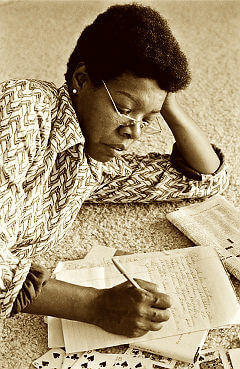
A tribute to Maya Angelou and her genius.

maya angelou writing 195x300 Maya Angelous Legacy: Inspiring Quotes for Writers

By Ana Parker Goodwin

The genius of a writer and poet such as Maya Angelou comes only once in a great while and the country will not forget her. She wrote 7 autobiographies, 3 books of essays and several books of poetry. Many movies and plays have also been attributed to her. In her many years of writing she has received dozens of awards and over 30 honorary doctoral degrees. She worked with Martin Luther King and often dealt with racism, identity and family in her writings. Some groups have tried to ban her books from US libraries but ultimately have not succeeded.

Again, as with so many other writers we will have to look at her history to help us understand her writings. Born in St. Louis, Missouri on April 4, 1928, as Marguerite Annie Johnson, she lived with her mother and father until their divorce when she was three. She and her brother were sent to live with her paternal grandmother who treated them very well. And then she was plucked out of her home by her father and sent back to her mother. Shortly after, her mother's boyfriend raped her. She told the family who he was and what he had done. The man was sent to prison for one day and then released. There had been no justice.

Three days later the man was murdered. Many people believed her uncles had killed him. And Maya (the name given to her by her brother) stopped talking for almost five years. In her first autobiography I know Why the Caged Bird Sings, she reveals why she became mute. As a young child she thought her telling about the rape and revealing his name had killed him. Her child mind believed that she would kill other people by speaking. So to prevent the death of others, she became mute. What did she do to survive during that long period of time and beyond while she worked in menial jobs and as a prostitute to make enough money to live? She read, read, read literature and imagined. It brought her through the dark days. During that time she learned to treasure words.

And something she understood more than most of us writers do, was the power of words. She knew that words could drive passions and make a difference. She writes, "Words are things---Some day we'll be able to measure the power of words. I think they are things. They get on the walls. They get in your wallpaper. They get in your rugs, in your upholstery, and your clothes, and finally into you." And yet in her first autobiography, I Know Why the Caged Bird Sings, she credited the human voice as being the true meaning maker of the words she wrote. She writes, "Words mean more than what is set down on paper. It takes the human voice to infuse them with the shades of deeper meaning." Did that deep understanding come from her self induced silence? In the same book she writes, "There is no greater agony than bearing an untold story inside you."

 I will leave you with another quote from her to encourage the artist in all of you. "You can't use up creativity. The more you use, the more you have."

And so we say goodbye to a brilliant writer, poet, and human who entered our hearts through her words. Thank you.

Monday, May 26, 2014

Memorial Day-Book to help Veterans and Families Cope with Severe Stress.

Stress after trauma F-Cover


My book How to Cope with Post Trauma Stress: Especially for Veterans, their Families, and Friends is on Amazon both as a Kindle book and a paper book in time for Memorial Day. It includes a stress test, relevant information about post-trauma stress (PTS), twenty steps to recovery, and help for the veteran's families and friends.

But, you say, memorial day is to honor the soldiers who have died to protect our freedoms. Yes, you are right. However, I believe that in remembering with love and appreciation all our heroes who have given their lives, we must also equally remember all those who have served us and survived. We cannot separate Memorial Day from Veteran's Day. Except for "the luck of the draw" the people who died and those who lived are the same, not one more brave and deserving than the other.

Many soldiers in the last two wars have survived because of modern medicine. Many, many veterans are coming home physically and emotionally injured. They are the ones who in the past were the ones who died. As you  have no doubt heard recently, one of the problems we are now facing, is that the country is not prepared to receive and help this many suffering veterans. There are long waiting periods in VA hospitals and doctor's offices. In the meantime veterans feel hopeless, deserted, and they are dying because of lack of care here at home instead of in a war zone overseas. They feel as though nobody cares. And to some extent they are right.

Because we now have a volunteer army, many people at home are no longer personally or meaningfully invested in what happens in the war. They are told to "go out and shop." The news rarely covers what is happening out on the battlefield, and we don't even see the coffins or wounded men come home. We forget they exist, or that we are at war. Of course, since Vietnam, ordinary citizens have learned a lesson they have not forgotten and that is to thank the veteran's for their service instead of calling them names.

That's great, but do people really see the veterans and their loved ones as human beings like they are? Can you personally step into a veteran's shoes and put yourself in her/his place? Or are the veterans merely "out there," distant from you? Do you know really what they are going through or would you rather inadvertently close your eyes to their needs and their suffering? Did you personally know what was going on in the VA? Did you care when you found out?

So what is the solution? How can we help our veteran's reintegrate when they come home? Ed Tick in his book  War and the Veteran's Soul: Healing our Nation's Veterans from Post Traumatic Stress Disorder, calls war a soul pain, a spiritual, and moral injury. Tick gives a powerful example in his book of how things could be different. He tells the story of how the Native American's once sent their warriors off to fight for them and how they reintegrated them.

When the veteran's returned, the entire community would sit in a circle and gather around them. They would allow their warriors to truthfully tell their stories of both the "good and bad things" that happened in battle. The community did not shame or judge them for what the warriors had done. Instead they shared the warrior's joy, their guilt, and their grief. After all, the tribe had, as a whole, sent the warriors to fight to protect them. The entire tribe listened, they held the returning warriors, and loved and supported them through their time of reintegration (sometimes for months) until they could stand alone again.

What would happen if we helped our warriors reintegrate in this way? It is time for everyone, individually, to take responsibility for our wars and our veterans. We, as a nation (yes, that means all of us personally) have sent the men and women to war and everyone of us must take responsibility to reintegrate them into our society, and not just with money. It means a personal investment in a veteran or veterans that you can help, love, and support physically and/or emotionally.

This book is my contribution to hurting veterans. If you know a veteran or family member who could use the help given in this book, please let them know about How to Cope with Stress after Trauma: Especially for Veterans, their Families and Friends.

Think about what you personally can do to help our veterans reintegrate and share it with the rest of us this Memorial Day.


Friday, May 2, 2014

Writings that Inspire you to take Action: The Man who Planted Trees


Bristle cone pine- oldest known species on the planet
9781400069064


This is a story of hope and how everyone can make a difference in changing the world. Twenty years ago David Milarch was just another ordinary man. Yes, he owned a nursery in Michigan, but most people that knew him thought of him as a hard-living alcoholic who would never amount to much. Certainly he was not someone who would someday inspire thousands of people to plant trees.

And then it happened. He had a near death experience and during this time he had a vision - a vision of angels who told him that the earth was in trouble and the trees were dying. Without them human life would have difficulty surviving. He was told to clone the oldest trees that still survived on the planet, like the redwoods, sequoias, and the bristlecone pines (One is believed to be 5,000 years old).

Why? Because some of these trees in the old growth forests had lived for thousands of years and were clearly the most resilient trees on earth. He was to plant them, not only in America, but all over the world.

David Milarch survived and changed his life. He became obsessed with his new mission. Scientists and other tree experts told him that cloning the trees couldn't be done. But over the years he and his team learned how and did it.

The author, Jim Robbins, a New York Times journalist, found out about David Milarch and his work. Although skeptical, he followed the team for several years and discovered the true benefit of our trees. He was surprised about what he learned, and was inspired to write this book.

He learned that trees even have a way to communicate with each other and the earth. Trees not only take in carbon dioxide from the atmosphere, but they filter our water and clean up toxic spills. They protect us and hundreds of areas from overwhelming heat and UV rays. For many of us who live in cities and suburbs, they become our natural air-conditioners. Some trees, like the willows, contain salicylic acid, and other trees contain other medications.

Milarch states that trees are the filters on the earth and without them we probably would not survive. His wish is to have everyone plant at least one of the old growth clones he is creating and spread the hardiest of trees all over the planet. Many people are doing just that.

My husband, who is one of those tree lovers, planted two sequoia trees in our back yard. We are watching them grow.

An old Chinese saying: When is the best time to plant a tree? Twenty years ago. The second best time? Today.

May this inspire you to plant a tree.

Wednesday, April 30, 2014

Why Do Readers Love Mystery Thrillers?


by Ana Parker Goodwin

Why do Readers Love MysteryThrillers?

As a person who has studied psychology and worked as a psychotherapist for many years and now writes mystery thrillers, I tend to always come back to the central question, "Why?" Why do so many people love mysteries and mystery thrillers? What is it inside so many of us that attracts us to these books and movies?

Even very young children love mystery books and thrilling adventures. When I was a child I loved to read Nancy Drew and the Hardy Boy books and I would spend many hours on the sofa at home curled up with a blanket reading, reading, reading. At school the teacher allowed us to go to the library when we completed our work and my friend and I would race to finish and then race to the library. We would vie to get the newest mystery book on the shelf. Then when I was older I read every Agatha Christie book I could find.

After writing professional books and articles, and retiring from my profession, I began to look around for another challenge. I decided to try my hand at writing fiction. I spent many hours studying the art of fiction writing, which is quite different from what I knew. I thought that maybe I would try romance. "That should be easy," I said to my husband. He looked at me with that big question mark on his face like he does when he thinks that I've gone a little out of my mind. I ignored him. Why not, I thought? I know about relationships. I've counseled lots of couples. Even helped them become more romantic.

To make a long story very short, or rather a short story very short, I "sucked" at writing romance. Boring. Every romance story I wrote turned into a mystery with thrilling events that had nothing to do with romance. At last I came back to my husband and asked him to be honest with me. He laughed. "Ana," he said, "You know you have always loved a good mystery. Look at what you read." So I did. Agatha Christie when I was in college, then John Grisham, now Preston and Child.

By the way, I love books that continue with the same character especially when the person is unique like FBI agent Pendergast. And now Preston and Child not only carry the character into the next book, but also the plot. They end many of their books unresolved and continue the story in the next book.(If you like a book that concludes the mystery at the end and makes you feel all fuzzy and satisfied inside, their books are probably not for you.)

Okay. He was right, but why along with so many other people was I drawn to these books?

Before I decided to write mystery thrillers I asked several people I knew why they read mostly books in this genre. What I learned was that most of us had certain things in common.

Here is what I found:

1. We had loved mystery books even as children.

2. We were all very curious about, "What happens next? Who did it?" Some people spent hours trying to figure out the answers.

3. We loved a great mental (analytical) puzzle with lots of twists and turns and unexpected endings. It kept our brains stimulated and exhilarated, and therefore we felt satisfied and happy (most of the time) especially at the end.

4. We loved excitement and these books took us out of our present world into a new world of intrigue, excitement, and conflict  without actually having to risk our own lives and sanity in the process.
So there it is. Mystery Thrillers. I love them. I may be a little weird, but I take comfort in that I am not alone. Millions of people love them as well!

Leave a comment and let me know why you love mysteries or mystery thrillers.

Oh, by the way, why don't you mystery thriller lovers read my book "Justice Forbidden" (only $2.99 on Amazon Kindle) and let me know what you think.

Monday, April 28, 2014

Inspiration in Memoirs, Mao's last Dancer. Learn about other cultures.


What an incredible story! What an incredible life. Many of you may have seen the movie "Mao's Last Dancer," but how many of you have read the 500 page book memoir of Li Cunxin? It is absolutely inspirational. What a motivated, brave, and courageous youth.

But what I loved even more than the story itself was learning first hand from someone who lived and experienced the culture of China during a time of enormous chaos and change. In his early years he lived in rural china with his large close knit family practicing the centuries old traditions of his land (He tells us about those traditions.). He talks about what he and his family and friends felt and experienced as the old traditional culture crumbled and Mao's communist party took over and ruled. And where the culture is now. He shows us how deep his need for freedom was and what he had to do to realize that dream.

As a part of Madame Mao's new project for the arts, Li was taken out of his home at the age of eleven and relocated to Beijing where he studied ballet. Except for a short time at home most summers he spent the next years groomed in the communist party. Over time he became a famous dancer both in China and in America.

And here is the wonder of memoir. Sure, I've read history books and even learned about different cultures from books and TV shows. History is interesting but it is written from an observer's position. It is his story not mine. No outsider could have truly known what that period in China's history was really like for the people living it. Others can write about it but they can only imagine and tell what they see from their perspective.


As the world grows ever smaller and we long to live in peace with all cultures and peoples, it is essential that we learn and experience who they truly are through their eyes, not ours. It is only then that we can empathize with each other and gain compassion for everyone. Memoirs that incorporate the experience, the thoughts, and the strong emotions, as well as the spiritual beliefs the author lives by. They provide us with the 3-D pictures of the past that we can get in no other way. And that is why I am writing the stories as told to me by my father when they escaped Russia in 1924. How about you? Is there something in your life you need to write about?

Friday, March 21, 2014

Writing Creative Non-fiction, My Father's Escape from the Soviet Union

by Ana Parker Goodwin

The 1917 Russian Revolution

Storming of the winter palace in October, 1917

My father and his family escaped from the Soviet Union shortly after Stalin came to power. They fled their home near the Caucasus Mountains in February of 1918 and hid for almost 6 years before they escaped to Canada. His stories when I was young were frightening but also inspiring. I learned something about the human spirit I will never forget. People's strength, bravery, and determination to live free can be much greater than any fear they have. My dad used to say to me, "Anna, of course we were scared. But we knew that our freedom to speak and freedom to worship the way we wanted to, were more important than any of those fears. So we just kept going." His stories have influenced me in my life in endless ways, and I hope they will help others as well. He would have wanted that.

And that's why I am writing his story. To remind everyone to "keep on the lights" even when there is darkness outside. I have found no better way then to write this story as a creative nonfiction tale. No, I don't know exactly what happened to him, but I have listened to all his stories over and over again. I have added other people's memories and done lots of research, but in the long run the details are part of what I imagined in my mind as my father spoke. That's why creative nonfiction is called creative.

On the other hand there is nothing that anyone remembers accurately anyway. With new brain research we know that it's not how memory works. We add and subtract what we think is fact continuously, and reconstitute our memories. Have you ever been surprised by your brother or sister's story of an event you remember quite differently? I have. It is obvious that each one of our perspectives of an event is different. One sees the forest, one sees the tree, one sees the ground, one sees the sky, and we filter out the rest. That's why we call history, his story.

Here is the first of about twenty stories of the families escape.

                                                              Escape to Freedom

Story 1

 
Feb. 6, 1918. Southern Russia. The Tereker Settlement, a collection of 17 German villages, located north of the Caucasus next to the Caspian Sea. (See map) Anarchy erupts.


Thirteen year-old Neil bolted upright in bed as he heard a loud knock on the front door. Men’s voices. He felt his body stiffen and his heart thump hard under his wool pajamas. He stared into the darkness. For two months now the Tereker Settlement had prepared, been on alert, waiting for the Tatars from the Caucasus Mountains to descend on them. Everyone knew that several villages to the south had already been plundered, robbed, whole families killed by young men from the mountains who refused to live in poverty anymore.

Another knock. Then his father’s firm footsteps. The front door creaked open. A familiar voice said, “We are waiting for Rudolph. He is the sentinel tonight.” Neil let out a long breath. It was one of the neighborhood men.

A din of voices erupted over each other as Neil heard boots drop on the floorboards, then moments later the scraping of chairs.

“Shh, You’ll wake the children,” Papa said. “They are too young to know.” The men’s voices quieted to a murmur.

Neil leaned over his younger brother lying next to him and checked to make sure Gerhard was asleep. Without making a sound, he slid off the feather mattress and tiptoed to the single plank wall that separated his bedroom from the main room. His fingers trembled as he pulled out the secret knot in one of the boards, almost dropped it, then peered through the small hole. Papa had better not find out about his eavesdropping post or there would be a word whipping in store.

Around the table about ten feet from Neil, four men in heavy jackets, and his father sat huddled together, examining a sheet of paper. Their caps lay on the table in front of them. The flame from the lamp flickered upward for a moment and Neil saw the men’s faces, their lips taut and jaws clenched.

The men whispered to each other. Neil pressed his ear to the hole, hardly breathing. He strained to listen. All he could hear were snatches of sentences. A global war …Russia in chaos…Czar Nicholas II overthrown and he and the family were now prisoners of the communist party somewhere…few government soldiers left to protect the villagers…two men from the settlement…gone into the mountains to negotiate with the Tatars for their safety…beaten and dragged to the roadside…found today…stench of rotting corpses…vultures.

Neil jerked as he heard another knock on the front door. He looked through the knothole again and saw his father hurry to answer. A man from across the village rushed in and strode to the table, his muddy boots squishing on the floor.  

“Rudolph. What’s happened?” Papa forgot to keep his voice down. He closed the door and hurried after Rudolph. “What have you found out?”

Rudolph pulled off his calfskin mittens and tossed them on the table. His breath came fast. “People say a thousand young Tatars on horseback are riding down the mountains in our direction.”

Neil gasped and his jaw dropped. They would all die.

“What?” the neighbor said as he jumped to his feet. “Are you sure?”

“Who told you this? It may just be a rumor,” Papa said.

Without waiting for answers the men got up, grabbed their caps, and charged to the front door. They pulled on their boots and rushed out. Papa tugged his cap and jacket from a hook on the wall near the door and hurried after them. In a few minutes all the men, including Papa and Rudolph, were gone.

Frozen, Neil kept staring through the knothole. What should he do? Wake up the family? Hide? No, Papa would soon be back. He’d know what to do. Finally Neil tiptoed back to his bed. He knelt down in prayer. Please, please, God, help me be strong.
 
 
Reader, do you have a story of a true event you feel you "need" to write? Try creative nonfiction. You can make the story more interesting, powerful, and come alive for your reader.

Wednesday, March 19, 2014

Are Large Publishing Companies Dying?


New York, the place of the large publishing companies.


As a writer I often wonder what is happening to the large publishing companies at present. With all the changes occurring, will they survive? With the advent of e-books, readers, and print on demand, the old style publishing companies are losing ground. And as the large companies take fewer and fewer first time authors, individual self-published authors and small companies are gaining momentum. It is now quite simple to publish your own books if you wish to, and because at this stage, large companies have stopped promoting your book even if they accept it, authors see fewer and fewer advantages to going that route.
 
Besides, you don't need to send out massive numbers of queries to find an agent, or receive just as many rejection notes even if you are an excellent writer. A friend of mine once said, "Why pay a $1000.00 for paper and postage, then wait six months, just to receive enough paper back to cover my bathroom walls?" So guess what he did? He went to Create Space on Amazon instead. He published his book in a couple of months, not 1-2 years, like it takes after your manuscript is accepted by a large publisher. More and more, even prestigious writers are switching to self-publishing when their contract is up. Why? Because if they are lucky, their large publisher takes only 90 percent of the profits. If they publish the books themselves, they receive a hundred percent and have the freedom to do with it what they wish.

But whether the large publishing companies die or not, it seems to me that the more important question to ask is whether, at present, these companies truly serve us, the reader. Are the books they issue relevant to our needs? Will what they publish help create a better world?

When I sold my first book, Sandplay Therapy, to W.W. Norton in 2000, my editor bemoaned that Norton was one of the last large publishers still accepting books just because they needed to be out there. They needed to be read. I must confess that although I had worked with people for years and didn’t consider myself naïve, I was shocked.

Why did publishers no longer follow their hearts?

What I found when I investigated was that there were only approximately six, large publishing houses left in America.

“But,” you say, “I’ve seen the names of loads of different companies on the spines of book jackets.”

Most of the old companies have merged and are now subsidiaries of a larger publishing house that sets down the rules.

 “So what?” you say.

Of course this is merely a theory, but I propose, “It‘s all about priorities.” As the companies have grown, their priorities have shifted. When people, or a group of people, change priorities, their actions change as well. There was a time when you and I the reader came first. Profit came second. But I think that’s been reversed and money is now number one.

Because of this, publishing houses buy mostly known winners such as Stephen King and John Grisham, who are then pressured to write endless sequels to their first successful book or novel. I don’t blame the publishers. Many of the authors are excellent writers. But what happens to our reading options? They are narrowed to a few viewpoints. Where are the creative, original thoughts of the many that have in the past helped to make this country great?

I’m afraid I’ve probably brought up more questions than answers but I’ll leave you with one more. Can any corporation survive over time when it forgets about the people it serves? I’m not sure, but I hope not. Maybe this means that large companies will change. They are already publishing e-books and making some changes to stay relevant. Maybe they will go back to publishing the books we as readers all need to and want to read, instead of just books that make a lot of money. I'm hopeful.


 Madison Ave., Chicago, IL, ca. 1915.

 
                       The Good Old Days      Detroit Publishing Company 1915


Monday, March 17, 2014

St. Patricks Day. What is Myth? What is Fact?


patron saint, patron saint of ireland, st. patrick, christianity, st. patrick's dayLuck o the irish clip art badge

Today is St. Patrick's Day. As a writer I am always interested and constantly checking on what is myth and what is fact. Of course sometimes no one seems to know, especially when a person lived hundreds of years ago and record keeping was minimal. Most of history was word of mouth. That's a little like playing the game telephone when you were young. "Mother" may turn into "father," and "house" may turn into "mouse." I guess what I'm saying is always take these stories with the proverbial grain of salt.

The person we now call St. Patrick, patron saint of Ireland, maybe was born in 385 A.D or 415 A.D and maybe died on March 17th, (St. Patrick's Day) 461 A.D. or 493 A.D. Was he Irish as most people believe? No. He was born in Britain though no one seems to be sure where. Maybe England, maybe Wales.

Actually, although many people believe he was poor, Maewa Succat was born into an aristocratic family. His parents were Romans living in Britain in charge of the colonies. But here comes the interesting part. At the age of 16, Irish raiders or maybe pirates, kidnapped him and took him to Ireland where they sold him to a farmer to work in the fields. He became a sheepherder. For six years he was what we would probably now call a slave. At the time Ireland worshipped a pagan God, but Britain had already converted to Christianity. One day Maewa heard what he believed to be God's voice inside of him say that it was time for him to return to Britain. He escaped and returned to Wales to his family. Shortly after he went to France where he became a Catholic priest. He took Patrick as his Christian name.

Again Patrick heard God's voice, this time telling him to go back to Ireland and preach Christianity. Patrick did as he was told. He became a missionary and he and his followers brought thousands to Christ. They built many churches. Even today, the Irish consider him to be the person who brought Christianity to Ireland and they honor him as a religious figure in their churches and also as a cultural icon.

According to some, St. Patrick used a shamrock to show the native people what he meant when he spoke of the Christian doctrine of the trinity. The three leaves. Was that really true? No one seems to know for sure. According to some the shamrock did not exist in Ireland but indeed the clover leaf did. On the other hand some believe the shamrock was the symbol of the cross. So who's to tell?

And then there is the story that St. Patrick banished all the snakes from Ireland. But we have since found out that no snakes ever lived in Ireland. As a matter of fact, Ireland is an island and the passageway between Britain and Ireland is so cold no snakes would have survived. I asked myself why some people had created the myth and what I came up with was that indeed there were no snakes in Ireland when the myth began, and because humans always need to make sense of things, people decided to attribute it to the great hand of God through St. Patrick. But this is what I learned. Apparently snakes had become the symbol for paganism in the church. And so the myth was born. Interesting.

What we know today is that alcohol always seems to flow freely on St. Pattie's Day. Why? Sounds strange seeing as it is a religious holiday. I thought it was just because that's the way the Irish were. Heavy drinkers. That to some extent may be true but there is more to it. March 17th often occurs during Lent. One thing you are to give up for Lent is alcohol. But the church gave a dispensation for St. Patrick's Day and wow! People have taken advantage of it. The holiday has turned into an alcohol fueled revelry, parades, celebration, and festivals. And by the way the parades did not originate in Ireland. They started in America in 1737.

In 1996, the Irish decided to begin a day of festivals in Dublin to attract tourists. By 2009 that one day had turned to five days and about a million people attended.What fun! I'm glad the Irish have a sense of humor and like to enjoy life. Without it life could definitely become a drag.

Who cares what is fact or myth?

Guess what I am making for dinner tonight? Is it true that corned beef brisket and cabbage began in Ireland? Not really, but if I keep going I'll never end this blog.

The luck of the Irish be with you dear readers.

Friday, February 7, 2014

Yea! The Winter Olymics in Sochi, Russia start today. Where is Sochi anyway? And what is it's History?


The winter Olympics are starting today in Sochi, Russia. Sochi, Russia? Why Sochi? When I first heard the name of the city I had no idea where it was although I was sure I had heard the name before. Sochi, Sochi. Then I remembered---I'll tell you about how I am connected to Sochi later.

I love the Winter Olympics. All that skiing, figure skating, speed skating, hockey, bob sled racing, and curling. Wow! That feels like "old home week(s)." I grew up in Manitoba, Canada about 30 miles southeast of Winnipeg. Miles and miles of flat prairie. We could hardly wait for snow to fall and the ice to freeze so we could all get out our sleds, the girls could get on their figure skates, and the boys their hockey skates. Then there were endless weekends we watched our home team on the ice and cheered and shouted until we were hoarse. So yes, I am an ardent watcher of the Winter Olympics.

When I first heard the Olympics would be help in Sochi, Russia, I decided to find out more about this Russian city so I looked it up on the internet.

"What?" I said to my husband. "The Winter Olympics in Sochi? It's halfway on the eastern coast of the Black Sea near the border of Georgia. That's humid, subtropical climate out there and the temperature rarely goes under freezing." Apparently it used to be swampy with lots of Malaria. Ugh. It rains 59" a year. I could tell you more stories of how they got rid of the mosquitos with what we now call biological control, but that's for later on in the blog.

"That is strange," he said looking up from reading his Science News magazine. (By the way, Ron grew up in California and doesn't like snow, but was an avid skier when he was young. He loves the Olympics as much as I do.)

I read more, then said, "Okay, that makes sense. It's near the Caucasus Mountains. The ski resort has one of the most powerful snowmaking machines in the world and the Russians feel very confident that they will have plenty of snow for the weeks of the Olympics. But wouldn't Siberia have been easier?" I hesitated and read on. "Okay. This makes even more sense," I said. "Sochi is the major resort in Russia. Putin and all his rich buddies have their second homes there. And Joseph Stalin plus most of the Russian leaders after him had homes there as well. It's the place the powerful and beautiful people come for vacations. I think Putin is trying to make a great impression on the world."


Sochi was a city of 334,282 people in 2002, and it is probably a little larger now. The city has palm trees, parks, and extravagant architecture and the surrounding area grows and sells a special tea the Russians love. It was first populated by the people of Asia Minor many years BC.After the 15th century the government called the city Ubykh. It was occupied by a local mountaineer clan that lived there until 1864 when the Russians, who had conquered the area in 1829, decided that the native people were no longer welcome. Most of the local, mostly Muslim, population left and migrated to Turkey.

In 1896 the city was called Sochi and was developed for sanitoriums and hospitals. There was only one problem with the place. Mosquitos. The Sochi area was mostly swamp land and the mosquitos bred and carried malaria to many of the inhabitants. Not a good place for hospitals. The Russian people drained the swamps. But this didn't solve the problem. So between the years of 1921-1925 they planted Eucalyptus trees. The trees consumed some of the water, but even that was not enough to get rid of the mosquitos. Then in about 1925 they dumped mosquito fish into the swamps. The fish ate most of the larvae and that was basically the end of the malaria problem in Sochi. Wow! What a great experiment in biological control.

During World War II Sochi became a major rehabilitation center with many sanatoriums and hospitals, and it has remained so to this day. 

As I promised early in the blog, I'd like to tell you how I am connected to Sochi. When I looked at the map and found Sochi, I felt shivers run down my arms. I suddenly remembered where I had heard the name. My father. Although German, he grew up in a thriving village on the Caspian Sea fairly near Grozny.

During the Russian Revolution of 1917-1919 anarchy swept through Southern Russia as the Czar's troops battled for survival and lost. In February, 1918, a 1000 man Tatar army rode down from the Caucasus onto the villages and slaughtered people, pillaged homes, and burned crops and houses. My father and his family escaped merely a few hours before the Tatars arrived. They travelled by horse and wagon to Sochi and then up to the Ukraine by rail and horses.

How did they survive? Several villages of kind Muslim people sheltered them and fed them. Neither spoke each other's language but they understood each other. My dad's immediate family hid for six years and escaped intact to Canada through Latvia in 1924. Many others of the extended family were not so lucky. Several of them were sent to Siberia to work in the mines. But something amazing happened in 1995 after the Soviet Union collapsed. My dad received a letter from one of his cousins in Siberia, and they began to communicate again.

So for me, Sochi is an important place. I pray that the people at the Winter Olympics remain safe and have a wonderful time.

And now that I am finished with my self-help book How to Cope with Trauma after Stress: Especially for Veterans, their Families, and Friends, I will continue writing my book about my father's escape from Russia. I call it, Escape to Freedom. The book will include some pictures and history of the area, plus twelve personal stories my father used to tell me about the family's escape from Communist Russia. I hope to finish it this year---the year of the Sochi Winter Olympics.

Wednesday, February 5, 2014

I did it! I Finished Writing my Self-Help Book: "How to Cope with Stress after Trauma"


cope_with_stress

I did it! I have just recently completed my self-help book called How To Cope with Stress after Trauma: Especially for Veterans, Families, and Friends. It will be published at the end of February and you will be able to get it on both Amazon books and on Kindle. Although I have addressed  the book specifically to veterans, and the examples are of veterans, the 20 steps I write about are just as valuable for anyone who is suffering from a severe trauma such as a sudden death, an accident, abuse, or a natural disaster. It is also for their families and friends.
 
Why does someone like me write self-help books? I'm not sure about others. I imagine some people see a relevant problem they can explore and turn into some money. But for me, the topic I would be willing to explore so deeply that I could actually write a book about it and try to help others, has to do with what I have felt passionate about in my life. Of course it also has to do with my knowledge and experience working for many years with clients who had PTSD (Post Traumatic Stress Disorder).
 
 There were lots of times over the last two years that I wanted to press the delete button on my book file but somehow I kept coming back to it. If you are a writer you will understand what I mean. "It's garbage" I said to myself. "No one would want to use this book, never mind read it. What do I think I know that's so important?"
 
Now looking back to those days I can see what motivated me to keep writing: my love for my father. He had been severely traumatized during war when he was young, He suffered with symptoms of post trauma stress most of his life. My mother, my sister, and I suffered too. But none of us knew how to "fix" him although we very much wanted to. At the time we didn't even have a name for what was going on. Now that I do have the knowledge of how to help, I want others like him and their families to find ways to recover and live productive and happy lives. That is my goal, and that is why I write self-help books. Are there any other self-help writers out there? Share with the rest of us about what motivates you.
 
 
Here is the beginning of Part 1 of the book How to Cope with Stress after Trauma:
 
Before I get started revealing information and ways to cope with stress after a trauma, I’d like to tell you a story.  I was well known in my community for my work with people who dealt with severe trauma, and agencies often referred clients to me, sometimes as far as two hundred miles away.

Years ago, while working in my private practice, a husky, muscular man, then in his mid- thirties came to me via the Veterans Administration (VA). It was about ten years after Joe’s tour of duty in Vietnam and he had survived without help, although he reluctantly admitted to having problems sleeping and some nightmares about Vietnam.

Joe had been employed at a saw mill for several years and he loved his work. Recently the owner of the adjoining property had opened a gun range and soon after, Joe developed a phobia to what he called “loud noise.” Every time he heard a shot, he jumped, covered his head, and crouched behind a pile of logs. His heart raced and he shook for several minutes.

Understandably, he decided to change jobs.

He expected his phobia to end, but instead, now when a car backfired or he heard a loud bang, he reacted in a similar way that he had to the gunshots. Over the last couple of months he had spent much of his time trying to avoid people and loud noises. He had frequent nightmares and woke up sweating. He couldn’t work. At this point he slept very little, and he had become unpredictably explosive at his wife and children. She was threatening to take the children and leave if the problem didn’t stop. In plain words, his life had become unmanageable.

When he arrived in my office, I noticed his face was drawn and his hands trembled. The first words he said to me after he explained his symptoms were, “This has nothing to do with Vietnam.”

I took a deep breath, nodded, and said, “Then let’s find out what’s really going on.”

I asked him to tell me his family history, starting with his childhood. He told me that his father was an alcoholic and that life at home had been difficult. Within less than five minutes he began to vividly relate stories about his experiences on the front line in Vietnam, as though they had happened yesterday.

In time, Joe dealt with his symptoms and eventually with his memories. During our year together, Joe did not forget his two years in Vietnam, the hand to hand combat, the many men in his platoon who died, the women and children he thought he could trust but who carried weapons, the innocent people he killed in the villages. Most of all he never forgot the guilt and shame he felt when he came home, and instead of a hero’s welcome, he was shunned or ignored.  Yes, the memories were still there but they were much less intense and they no longer triggered flashbacks and nightmares. His anger subsided and after a short separation from his family he returned home.

Why did I start the book with Joe instead of defining words or listing symptoms? Because I think it’s important to understand the lessons taught in Joe’s story. Regardless of which war you fought---World War II, the Korean War, the Vietnam War, Operation Just Cause in Panama, the Gulf War, Operation Iraqi Freedom, Operation Enduring Freedom in Afghanistan, or any other war---the lessons learned will be similar.

The first lesson:

Don’t make excuses or ignore your first symptoms of post trauma stress. The sooner you deal with the symptoms, the more likely they will recede into the past without you becoming dysfunctional, or have what psychologists call a “disorder.”

 
The second lesson:

Although most post trauma stress occurs immediately or shortly after a trauma, delayed reactions are fairly common. It may be months, sometimes years, before they manifest in the conscious mind. According to recent reports, after 40 years, Vietnam veterans are increasingly having nightmares and flashbacks now that they are getting older, are retired, and have more time to think. Usually there is a trigger. For Joe the trigger became gun shots. For others it may be the death of a loved one.

  
The third lesson:

You are strong, not weak, when you face life and deal with it as it happens instead of pretending there’s nothing wrong. You are strong, not weak, when you ask for help. Anyone, and I mean anyone, may react to trauma in a way similar to Joe’s response. Use some of the steps in this book to help you learn how to cope, but if they don’t relieve your symptoms, see a psychotherapist and/or a medical doctor.

 
The fourth lesson:

You are not alone even though you may often feel like you are. Certainly, you are unique as to the circumstances and specifics of your trauma, and it is very important for you to meet with other veterans who can understand you in a way civilians at home can't. But regardless of the severe trauma people have been exposed to, whether it occurred in war, in an accident, or natural disaster, or at home in an abusive situation---sometimes for many years---and regardless of who the survivors are, all are humans. Their bodies, especially their brains, control their emotions and their minds and will respond similarly. Some will react more severely and some less so, and for more or less time, but millions of people around the globe experience trauma symptoms although different cultures may respond and answer questions about trauma symptoms somewhat differently.

 
The fifth lesson:

Recovery is possible. If you get help, your symptoms will most likely lessen to a point where they are easily managed.