Wednesday, April 2, 2014

Recipe Details: Too Much or Too Little?

It started out innocently enough. The gravy for the roast looked a little thin, so I reached for a packet of gravy mix to bulk it up a bit. The directions on the packet yielded this sentence:

"Boil 1 cup of water in a saucepan."

"Well, of course, in a saucepan," I muttered darkly. (I'm often guilty of muttering darkly when I cook, especially when confronted with inadequate gravy.) "What else would you boil water in?" A teakettle would work for the boiling part, I suppose, but not so well for the gravy part.

The recipe continued. "Combine gravy mix and cold water in a bowl, using a whisk." Again with the muttering. "Why do they have to specify to use a bowl and a whisk? Do they think I'll sit down on the floor and make mud pies with my fingers?"

In retrospect, I see that my sour attitude that day had less to do with the directions on the package than with my disappointment over my gravy malfunction. Still, it got me to thinking about recipe writing and how it has changed over the years.

In my other life, I write a blog about all things vintage. Once a week, on what I call "Retro Recipe Wednesday," I like to post a recipe from long ago. Sometimes they're great and sometimes they're ghastly, but they always inspire nostalgia.

One problem I run into with these old recipes is their imprecision compared to today's recipes. Not only do they neglect to instruct the cook to use a bowl or a spoon, but they often omit oven temperatures entirely and call for vague measurements like "butter the size of an egg." Would that be a medium, large, or jumbo egg? Chicken or quail?

To be fair, some very old recipes date from before oven-controlled ranges were available. My mom tells me that my grandmother could judge whether a wood-fired oven was ready by sticking her hand inside it to feel the air on her skin. Obviously a "slow" oven felt markedly different from a "quick" one.

I even saw an old cake recipe that listed the ingredients, instructed the reader to mix them together, "and bake." Nothing about the size of the pan. Nothing about the temperature of the oven or the length of time. Just "and bake," with the confident assumption that the reader would know what was needed.

Unless written specifically for the novice cook, older cookbooks assume that the reader knows what is meant by whip, stir, saute, and blanch. Sometimes there is a glossary printed at the back to define these terms, but the general assumption seemed to be that cooks would be familiar with these terms, perhaps learning them from their mothers or from home ec class at school. Today, not only is this level of knowledge not assumed, but neither is the knowledge that one boils water in a pan or mixes ingredients in a bowl.

This got me to wondering what social factors might account for the change. Are recipes now written for latchkey kids learning how to start supper before the rest of the family gets home? Young adults who grew up on fast food and microwave meals while managing to avoid both the home kitchen and the gone-the-way-of-the-dodo home ec class, who are now trying to feed themselves in their tiny apartment kitchens?

I suppose that, like adding salt and pepper "to taste," the amount of detail appreciated in a recipe boils down to personal preference.

What do you think? Have you noticed a change in the way recipes are written over time? If you cook, what level of precision do you like to find in your recipes?

Monday, March 31, 2014

Coming of age in Big Sky country: Winter Wheat by Mildred Walker

I didn't have the opportunity to raise any children. But if I had, I've always thought that a child's entry into young adulthood must be one of the most interesting times to be a parent: the most potentially rewarding, and yet the most weighted with worry. My own young adult years were fraught with choices and decisions that affected the future in profound ways, while at the same time, emotions ran high and maturity was perhaps not as fully formed as I hoped it was.

For these reasons, Mildred Walker's 1944 novel Winter Wheat appealed to me. Winter Wheat chronicles two years in the life of Ellen Webb. Growing up on a dry-land wheat ranch in central Montana's Big Sky country with a Russian-immigrant mother and New England-patrician father, Ellen understands hard work, relative social isolation, and a life lived at the mercy of the weather and the price of grain. Traveling to college in Minnesota opens her eyes (and heart) to a wider world. Later, teaching eight pupils in a remote one-room school, her world expands even deeper as she's tested by both natural and man-made circumstances. When a long-hidden family secret is revealed, she must grapple with seeing her parents not only as Dad and Mom, but as real people making their journey through life with a full load of baggage, just as she is.

Walker, a Pennsylvania native who spent several years in Great Falls, Montana, is a master at capturing
Mildred Walker
the Montana landscape and climate, both meteorological and social. "September is like a quiet day after a whole week of wind," she writes. "I mean real wind that blows dirt into your eyes and hair and between your teeth and roars in your ears after you've gone inside. The harvesting is done and the wheat stored away and you're through worrying about hail or drought or grasshoppers. The fields have a tired peaceful look, the way I imagine a mother feels when she's just had her baby and is just lying there thinking about it and feeling pleased."

In an introduction to Winter Wheat, author James Welch writes, "It is a story about growing up, becoming a woman, mentally, emotionally, spiritually, within the space of a year and a half. But what a year and a half it is!"

I recommend this novel especially to young women who are teetering on the threshold of adulthood, and to the adults who love them and who remember what it's like to have your whole life stretched out before you, as vast and open and lacking in signposts as a field of hard winter wheat.

What is your favorite coming-of-age story?


Friday, March 28, 2014

Dale Carnegie Agrees: Writers Need to Have Fun


When I was in the work-a-day, nine-to-five world, I always looked forward to "Casual Fridays" because we could wear jeans to work.  I miss that little bit of fun and having something to look forward to at the end of the week now that I write at home ... soooo ... I decided to lighten up my Friday post a little.  Enjoy!

BEFORE THEY WERE FAMOUS
AUTHORS MATCH GAME

Match the authors with jobs/positions they held before they became famous authors.  Answers are at the bottom of the page.

1. J.D. Salinger A. Manager of Saab Dealership
2. Kurt Vonnegut B. Reservations Clerk for Eastern Airlines
3. Agatha Christie C. Cartoonist for Playboy Magazine
4. Franz Kafka D. Entertainment Director for Cruise Ship
5. Harper Lee E. Licensed Pharmacist
6. Tom McCarthy F. West Point Cadet (Dropout)
7. John Steinbeck G. Chief Legal Secretary for Accident Insurance
8. Edgar Allen Poe H. Nude Model
9. Jack London I. Fish Hatchery Manager
10. Shel Silverstein J. Oyster Pirate

A WRITER'S BEST RESIGNATION LETTER EVER
If the duties of everyday life are worming their way into your writing time, you might consider following William Faulkner's example.  Before his writing career took off, WILLIAM FAULKNER worked for the Postal Service, as postmaster at the University of Mississippi. In his resignation note, he neatly summarized the struggle of art and commerce faced by many authors:
As long as I live under the capitalist system I expect to have my life influenced by the demands of moneyed people. But I will be damned if I propose to be at the beck and call of every itinerant scoundrel who has two cents to invest in a postage stamp. This, sir, is my resignation. - William Faulkner
A SCARY THOUGHT
Steven King received an English degree from the University of Maine, but couldn't find a teaching job after graduating and became a high school janitor instead.  After the publication of his first book, Carrie, King says he was inspired to write the book during his time cleaning the girl's locker rooms.

WORST BUSINESSMAN TURNED AUTHOR
October 29, 1692 A tireless and ambitious businessman, Daniel Defoe invested in a variety of enterprises: wholesale hosiery, cargo shipping, trade in spirits and tobacco, and a diving bell to recover sunken treasure.  Most memorably, he purchased seventy civet cats (a native African cat-like mammal called a "toddycat" in England) from which he planned to manufacture perfume from the musk recovered, by spatula, from their anal glands. As with earlier ventures, his foray into the perfume business ended with a loss when creditors seized his cats.  They hounded him for the rest of his life, even after he left business behind for the new and more successful profession of authorship.

Answers to Authors Match Game
(1) D, (2) A, (3) E, (4) G, (5) B, (6) H, (7) I, (8) F, (9) J, (10) C

Note: I created the match game myself and copied the other tidbits from Huffington Post and Wikipedia sources.


Wednesday, March 26, 2014

Early Morning Visitors: Arnold Hecht and Agatha Christie woke me up this morning!

By Mary Jane Honegger
Two things woke me up this morning … one a poem ...
and the second a documentary film. 

Anthony Hecht
January 16, 1923 – October 20, 2004)
Anthony Hecht
I finally heaved myself out of bed this morning when I couldn’t stop thinking about “The Book of Yolek,” a poem included in Liz Mastin’s post earlier this week.  The poem gripped me, and when I awoke thinking about it again today, I decided to learn more about the poem and the poet.

According to online sources, Anthony Evan Hecht was an honored American poet who based many of his most poignant poems on his experiences liberating a concentration camp near Buchenwald during WWII.  He was awarded the Pulitzer Prize for Poetry in 1968 for The Hard Hours, a collection of poems exploring his memories of the war.  

Liz included Hecht’s poem in her series, The Joy of Prosody, as an example of a poem written in the form of a sestina. In fact, Hecht combined a huge interest in poetic form with his desire to address the horrors of war; and became known for both.  In addition to the 1968 Pulitzer and other literary awards, he served as the Poet Laureate Consultant in Poetry to the Library of Congress from 1982 through 1984.

But what interested me about Hecht's poem was Yolek himself.  I began reading tales about the Holocaust when I was about 12 years old and I continue to read them to this day.  I'm not sure why other than it is my own attempt to find a reason.  Why did people turn the other way and let it happen?  Why did millions of people decide it was okay to murder innocent men, women and children?  By now I know we'll never understand, but reading this poem about a 5-year old boy reminds me never to forget.  And that, I think, is what Anthony Hecht wanted when he wrote this poem about little Yolek.   

Interesting Facts - Anthony Hecht
While in college, before the war, Hecht decided to become a poet, a decision that distressed his parents.  They tried to discourage him by having a family friend, Ted Geisel (better known as Dr. Seuss) persuade him to change his choice of career.  The plea didn’t deter him and after the war he used the G.I. bill to study with other poets.

Hecht and fellow poet John Hollander are credited with creating the double dactyl, a particularly complicated one-sentence poem with 44 syllables, eight lines, and two four-line stanzas.  Oh, and by the way, the first line must be a rhyming nonsensical phrase, the second line should introduce the subject, and one line in the second stanza (usually the sixth) must be a six-syllable, double-dactylic word.

Whew!  I think I’ll stick to prose.


Agatha Christie
Thoughts about a documentary film chronicling the life of the bestselling mystery writer of all time, Agatha Christie, also disrupted my sleep.  The PBS documentary revealed facts about Christie that I had never known … or didn’t remember, at any rate.  The one that struck me the most concerned how the prolific writer got her start.

While she was an aspiring writer from an early age, working in a pharmacy during WWI sparked her interest in the use of poison as her favorite method of causing someone’s demise.  She perfected the genre and began churning out books at an astonishing rate. 

With sales of over 2 billion novels translated into 45 languages, Agatha Christie is cedited with being the best selling author of all time. Throughout her life, she wrote 80 novels and short story collections as well as a dozen plays. Her play The Mousetrap is the longest running play in theater history. She penned some nonfiction, a few poems, and an autobiography. Christie also wrote six romance novels under the pseudonym Mary Westmacott.

She introduced her most famous character, detective Hercule Poirot , in her first novel, The Mysterious Affair of Styles.  She later introduced a second famous crime-solver, Miss Jane MarpleMiss Marple appeared in twelve of her novels and twenty short stories.  Many of her stories have been shown in film and on television, including Murder on the Orient Express and Death on the Nile. 


I was interested that Christie did not write about her experiences as a nurse and a licensed pharmacologist during the war, which I'm sure readers would find fascinating; but instead used her personal knowledge about poisons to enrich her fiction ... and commit the perfect murder.  When she took that job to stay busy and help with the war effort while her pilot husband was off fighting the war, I'm sure she didn't have a single clue that it would become her springboard to fame and fortune and the sale of billions of books.

Note to self and others: don’t give up.  You may find inspiration for your writing anywhere … in the chaos of war like Hecht, or in the mindless repetitiveness of everyday tasks like filling a bottle with pills like Christie.  An incredible idea may spark when you are filling the dishwasher, selling vacuums door-to-door, or chasing a two-year old down the aisle of the local supermarket.  It may come when you get lost on a freeway in California, when you have to start over again, or when you find your mailbox stuffed with MediCare Supplemental Plans the week before your 65th birthday.  

Interesting Facts - Agatha Christie
Agatha Christie's first book was rejected by six publishers.
When she killed off her most famous detective, Hercule Poirot, in her 1975 book, Curtain, The New York Times ran a full page obituary. Hercule Poirot remains the only fictional character ever given such treatment by the newspaper.

Her novel, Endless Night, is narrated by a young working-class male.  She wrote it when she was 76.

Poison was Christie's most common choice of deadly weapon, but she did allow some creativity.  In addition to using poison to dispatch her characters, Christie’s fictional victims were: strangled by a raincoat belt, strangled by a ukulele string, jabbed in the neck with a venom-tipped dart, stabbed with a corn knife, stabbed with an ornamental Tunisian dagger, drowned in an apple tub, crushed by a bear-shaped marble clock, and electrocuted by a chessboard rigged to deliver the fatal charge upon completion of the third move of the Ruy Lopez opening.


Monday, March 24, 2014

The Joy of Prosody: Writing the Sestina

By Liz Mastin


In the many books on how to write formal poetry, the “sestina” is often considered a complicated form; but in actuality it is not impossible to write, and I have written two of them. If I can write a sestina, you can write a sestina!  In sestinas, end words are repeated in a convoluted, spiraling pattern and one has the opportunity to change the meanings of the repeated words (for many words have more than one meaning).  The word “dog” at the end of one line which might read “How I miss the little dog”, might appear at the end of another line as “Do not my weary conscience dog!”

The sestina’s inventor, according to The making of a Poem, A Norton Anthology of Poetic Forms, was Arnaut Daniel, who belonged to a group of twelfth-century poets – the troubadours – who needed, for their fame and fortune, to shock, delight, and entertain!

The sestina does not rhyme as the repetitions stand in for the rhymes. In the sestina, elaborate repetitions manifest as one follows the prescribed formula.  The required pattern for the sestina is as follows:

1.       It is a poem of thirty-nine lines.
2.       It has six stanzas of six lines each.
3.       This is followed by an envoy of three lines
4.       All of these are unrhymed
5.       The same six end-words must occur in every stanza but in a changing order that follow a set pattern.
6.       This recurrent pattern of end-words is known as “lexical repetition”.
7.       Each stanza must follow on the last by taking a reversed pairing of the previous lines.
8.       The first line of the second stanza must pair its end-words with the last line of the first.  The second line of the first stanza must do this with the first line of the first and so on.
9.       The envoy (or last three lines) must gather up and deploy the six end words.

 Is easier to show how this works with a poem example. Many of the famous sestinas may seem complicated due to their more complex subject matter, so I think I will use my simple poem to show you how the repetitions works. Then I’ll add a serious sestina by a revered poet, Anthony Hecht.

Not the Place to Eat a Peach
                                     By Liz Mastin

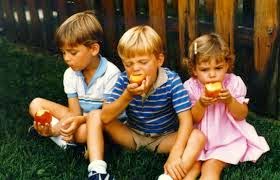
Upon seeing a young family, on an off-ramp, eating peaches!


Not the place to eat a peach –
On the off-ramp from I-5!
Many speeding cars turn down there:
Logging trucks with lumbering weight.
Highways really are quite foolish:
Stopping only tempting fate.

One may not believe in fate,
But should you choose to eat a peach,
The Flying J would be less foolish,
Up ahead four miles or five.
It’s so much better that you wait –
And you’ll find great coffee there!

Tell your children “Now there there!
Soon you’ll have a nice sweet fate!
Please be patient; try to wait
And you’ll soon have your nice plump peach!
Traffic is intense at five;
To step out now is foolish, foolish!”

Flaunting danger’s always foolish.
Logging trucks which exit there,
On the off-ramp from I-5
Head for the mill; that is their fate.
It’s not worth it for a peach
And what I’m saying carries weight!

Speeding cars will never wait;
They’re always late so it is foolish
Dealing with a messy peach,
Taking chances. You know there
Are some good reasons for ill fate.
Danger looms along I-5!

Beware all you who choose I-5
To eat a peach. You’d better wait.
You don’t want to meet cruel fate!
Move along and don’t be foolish.
I don’t want to see you dead there,
Damaged due to eating peaches.

 Sometimes something like a peach                                  
 Will brings about a foolish fate.
 Wait! Don’t eat there, on I-5.

NOTE: In writing my poem, I studied another sestina, and how the line-end-words were arranged.
Then, I numbered each stanza’s lines, and placed the correct end words at the end of each line and then begin to fill out the lines with some sensible (hopefully poetic) reasoning.

NOTE: In the first stanza, one is free to write whatever one pleases. From there is it only a matter of placing the end words in their proper order  in the following stanzas, according to the formula. It is a consistent pattern; “not” difficult once you get the hang-of-it.

Now here is a very “serious” sestina by a famous poet Anthony Hecht.

                  The Book of Yolek
                                      By Anthony Hecht

The dowsed coals fume and hiss after your meal
Of grilled brook trout, and you saunter off for a walk
Down the fern trail, it doesn’t matter where to,
Just so you’re weeks and worlds away from home
And among midsummer hills that have set up camp
In the deep bronze glories of declining day.

You remember, peacefully, an earlier day
In childhood, remember a quite specific meal:
A corn roast and bonfire in summer camp.
That summer you got lost on a Nature Walk;
More than you dared admit, you thought of home;
No one else knows where the mind wanders to.

The fifth of August, 1942.
It was morning and very hot.  It was the day
They came at dawn with rifles to The Home
For Jewish Children, cutting short the meal of
Of bread and soup, lining them up to walk
In close formation off to a special camp.


How often you have thought about that camp,
As though in some strange way you were driven to,
And about the children, and how they were made to walk,
Yolek, who had bad lungs, who wasn’t a day
Over five years old, commanded to leave his meal
And shamble between armed guards to his long home.

We’re approaching August again.  It will drive home
The regulation torments of that camp
Yolek was sent to, his small, unfinished meal,
The electric fences, the numeral tattoo,
The quite extraordinary heat of the day,
And the smell of smoke and the loudspeakers of the camp.
Wherever you are Yolek will be there too.
His unuttered name will interrupt your meal.

Prepare to receive him in your home some day.
Though they killed him in the camp they sent him to,
He will walk in as you are sitting down to a meal.

I hope you will try writing the sestina. It is not as hard as it might look and in fact is a very fun form.

Liz Mastin Bio
Liz Mastin is a poet who lives in Coeur d’ Alene, Idaho during the summer and Bullhead City, Arizona in winter. She thrives on the study of the great poets, their biographies, the schools of poetry to which they adhered, and the poetic conventions of the times in which they lived.

While she enjoys free verse as well as metrical poetry, her main interest lies in prosody. She notices that most of the enduring poems are those we can remember and recite. Liz enjoys poetry forms such as the sonnet, the sestina, the couplet, blank verse, simple quatrains, etc. and she hopes to see modern poets regain interest in studied metrical poetry.

Liz is currently putting together her first collection of poems which should be completed this winter. The poems are a mixture of metrical and free verse poems.


Friday, March 21, 2014

Writing Creative Non-fiction, My Father's Escape from the Soviet Union

by Ana Parker Goodwin

The 1917 Russian Revolution

Storming of the winter palace in October, 1917

My father and his family escaped from the Soviet Union shortly after Stalin came to power. They fled their home near the Caucasus Mountains in February of 1918 and hid for almost 6 years before they escaped to Canada. His stories when I was young were frightening but also inspiring. I learned something about the human spirit I will never forget. People's strength, bravery, and determination to live free can be much greater than any fear they have. My dad used to say to me, "Anna, of course we were scared. But we knew that our freedom to speak and freedom to worship the way we wanted to, were more important than any of those fears. So we just kept going." His stories have influenced me in my life in endless ways, and I hope they will help others as well. He would have wanted that.

And that's why I am writing his story. To remind everyone to "keep on the lights" even when there is darkness outside. I have found no better way then to write this story as a creative nonfiction tale. No, I don't know exactly what happened to him, but I have listened to all his stories over and over again. I have added other people's memories and done lots of research, but in the long run the details are part of what I imagined in my mind as my father spoke. That's why creative nonfiction is called creative.

On the other hand there is nothing that anyone remembers accurately anyway. With new brain research we know that it's not how memory works. We add and subtract what we think is fact continuously, and reconstitute our memories. Have you ever been surprised by your brother or sister's story of an event you remember quite differently? I have. It is obvious that each one of our perspectives of an event is different. One sees the forest, one sees the tree, one sees the ground, one sees the sky, and we filter out the rest. That's why we call history, his story.

Here is the first of about twenty stories of the families escape.

                                                              Escape to Freedom

Story 1

 
Feb. 6, 1918. Southern Russia. The Tereker Settlement, a collection of 17 German villages, located north of the Caucasus next to the Caspian Sea. (See map) Anarchy erupts.


Thirteen year-old Neil bolted upright in bed as he heard a loud knock on the front door. Men’s voices. He felt his body stiffen and his heart thump hard under his wool pajamas. He stared into the darkness. For two months now the Tereker Settlement had prepared, been on alert, waiting for the Tatars from the Caucasus Mountains to descend on them. Everyone knew that several villages to the south had already been plundered, robbed, whole families killed by young men from the mountains who refused to live in poverty anymore.

Another knock. Then his father’s firm footsteps. The front door creaked open. A familiar voice said, “We are waiting for Rudolph. He is the sentinel tonight.” Neil let out a long breath. It was one of the neighborhood men.

A din of voices erupted over each other as Neil heard boots drop on the floorboards, then moments later the scraping of chairs.

“Shh, You’ll wake the children,” Papa said. “They are too young to know.” The men’s voices quieted to a murmur.

Neil leaned over his younger brother lying next to him and checked to make sure Gerhard was asleep. Without making a sound, he slid off the feather mattress and tiptoed to the single plank wall that separated his bedroom from the main room. His fingers trembled as he pulled out the secret knot in one of the boards, almost dropped it, then peered through the small hole. Papa had better not find out about his eavesdropping post or there would be a word whipping in store.

Around the table about ten feet from Neil, four men in heavy jackets, and his father sat huddled together, examining a sheet of paper. Their caps lay on the table in front of them. The flame from the lamp flickered upward for a moment and Neil saw the men’s faces, their lips taut and jaws clenched.

The men whispered to each other. Neil pressed his ear to the hole, hardly breathing. He strained to listen. All he could hear were snatches of sentences. A global war …Russia in chaos…Czar Nicholas II overthrown and he and the family were now prisoners of the communist party somewhere…few government soldiers left to protect the villagers…two men from the settlement…gone into the mountains to negotiate with the Tatars for their safety…beaten and dragged to the roadside…found today…stench of rotting corpses…vultures.

Neil jerked as he heard another knock on the front door. He looked through the knothole again and saw his father hurry to answer. A man from across the village rushed in and strode to the table, his muddy boots squishing on the floor.  

“Rudolph. What’s happened?” Papa forgot to keep his voice down. He closed the door and hurried after Rudolph. “What have you found out?”

Rudolph pulled off his calfskin mittens and tossed them on the table. His breath came fast. “People say a thousand young Tatars on horseback are riding down the mountains in our direction.”

Neil gasped and his jaw dropped. They would all die.

“What?” the neighbor said as he jumped to his feet. “Are you sure?”

“Who told you this? It may just be a rumor,” Papa said.

Without waiting for answers the men got up, grabbed their caps, and charged to the front door. They pulled on their boots and rushed out. Papa tugged his cap and jacket from a hook on the wall near the door and hurried after them. In a few minutes all the men, including Papa and Rudolph, were gone.

Frozen, Neil kept staring through the knothole. What should he do? Wake up the family? Hide? No, Papa would soon be back. He’d know what to do. Finally Neil tiptoed back to his bed. He knelt down in prayer. Please, please, God, help me be strong.
 
 
Reader, do you have a story of a true event you feel you "need" to write? Try creative nonfiction. You can make the story more interesting, powerful, and come alive for your reader.

Wednesday, March 19, 2014

Are Large Publishing Companies Dying?


New York, the place of the large publishing companies.


As a writer I often wonder what is happening to the large publishing companies at present. With all the changes occurring, will they survive? With the advent of e-books, readers, and print on demand, the old style publishing companies are losing ground. And as the large companies take fewer and fewer first time authors, individual self-published authors and small companies are gaining momentum. It is now quite simple to publish your own books if you wish to, and because at this stage, large companies have stopped promoting your book even if they accept it, authors see fewer and fewer advantages to going that route.
 
Besides, you don't need to send out massive numbers of queries to find an agent, or receive just as many rejection notes even if you are an excellent writer. A friend of mine once said, "Why pay a $1000.00 for paper and postage, then wait six months, just to receive enough paper back to cover my bathroom walls?" So guess what he did? He went to Create Space on Amazon instead. He published his book in a couple of months, not 1-2 years, like it takes after your manuscript is accepted by a large publisher. More and more, even prestigious writers are switching to self-publishing when their contract is up. Why? Because if they are lucky, their large publisher takes only 90 percent of the profits. If they publish the books themselves, they receive a hundred percent and have the freedom to do with it what they wish.

But whether the large publishing companies die or not, it seems to me that the more important question to ask is whether, at present, these companies truly serve us, the reader. Are the books they issue relevant to our needs? Will what they publish help create a better world?

When I sold my first book, Sandplay Therapy, to W.W. Norton in 2000, my editor bemoaned that Norton was one of the last large publishers still accepting books just because they needed to be out there. They needed to be read. I must confess that although I had worked with people for years and didn’t consider myself naïve, I was shocked.

Why did publishers no longer follow their hearts?

What I found when I investigated was that there were only approximately six, large publishing houses left in America.

“But,” you say, “I’ve seen the names of loads of different companies on the spines of book jackets.”

Most of the old companies have merged and are now subsidiaries of a larger publishing house that sets down the rules.

 “So what?” you say.

Of course this is merely a theory, but I propose, “It‘s all about priorities.” As the companies have grown, their priorities have shifted. When people, or a group of people, change priorities, their actions change as well. There was a time when you and I the reader came first. Profit came second. But I think that’s been reversed and money is now number one.

Because of this, publishing houses buy mostly known winners such as Stephen King and John Grisham, who are then pressured to write endless sequels to their first successful book or novel. I don’t blame the publishers. Many of the authors are excellent writers. But what happens to our reading options? They are narrowed to a few viewpoints. Where are the creative, original thoughts of the many that have in the past helped to make this country great?

I’m afraid I’ve probably brought up more questions than answers but I’ll leave you with one more. Can any corporation survive over time when it forgets about the people it serves? I’m not sure, but I hope not. Maybe this means that large companies will change. They are already publishing e-books and making some changes to stay relevant. Maybe they will go back to publishing the books we as readers all need to and want to read, instead of just books that make a lot of money. I'm hopeful.


 Madison Ave., Chicago, IL, ca. 1915.

 
                       The Good Old Days      Detroit Publishing Company 1915