In the fifties, we had our milk delivered daily. It came in quart-size glass bottles with a pint of cream on the side. There was a little cabinet on our back porch with two doors. Our delivery man opened the small cupboard, gathered the empties which had been washed by my mother, looked for instructions which may have requested either more or less, depending on the time of year, and then placed our milk in its little home and went on to the next house. It was often my job to open the other side, housed as it was in the laundry room, and put the bottles in the fridge. Gifted with a crazy imagination, I went through the small opening, trying to prove that a skinny milkman could rob us blind if that were his intention. Everyone would scoff at my fears because a milkman was always in a position of trust.

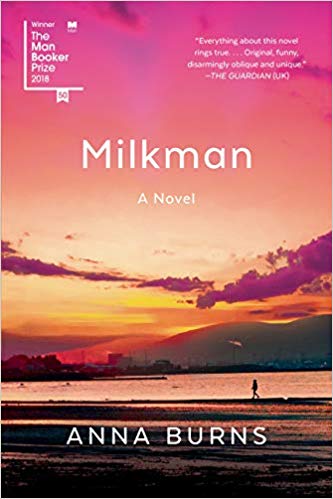
We learn in the opening pages of Anna Burn’s Man Booker Prize-winning book, named Milkman, that this is not a cozy tale redolent of all things shiny and secure as we now tend to think about the fifties. This book is set in Northern Ireland in the seventies at the height of what is usually referred to as the troubles, and the milkman was probably not a milkman at all, but a para-military, sinister figure, stalking the narrator.
“The day Somebody McSomebody put a gun to my breast and called me a cat and threatened to shoot me was the same day the milkman died. He had been shot by one of the state hit squads, and I did not care about the shooting of this man.” Page 1.
Kwame Anthony Appiah, chair of the Booker Prize judging panel, put it this way: “From the opening page her words pull us into the daily violence of her world- threats of murder, people killed by state hit squads- while responding to the everyday realities of her life as a young woman.”
The protagonist, recipient of not only the threat, from Somebody McSomebody but judgments and warnings from the rest of the community went mysteriously, unnamed. Her family is as well, and we distinguish them, one from another, through their place in the grand scheme of things. She is known as “middle sister.” To the best of my knowledge, this is a first. What fills me with enormous curiosity are these two questions: why did she choose to tell the story this way, and how was she not talked out of it?
The book is not given to explanations. The troubles, the author assumes are well-known to everyone and need no history lesson. The same goes for geography, and the nature of the conflict, the violence and mistrust everywhere in the community. People from “over the water,” or “over the border” or “over the road” are the anchors we understand. She never writes of England, or Great Britain, or Ireland or the west. Instead, she chose to write of the state, of the resisters to the state, to organizers and suspected para-military. It gives the setting a surreal, other-worldly aspect. There is something fantastical in the tale that I clumsily struggle to define. By using these devices, leaving names, and place names vague and untethered, we are forced to work a bit harder to find our own place for them. The heart of the matter becomes more prevalent because denied our judgments and bigotry; we must begin anew. The conflict starts to feel everlasting. If you consider that the Anglo-Norman claim to the Pale, the strip of land under their rule, goes back to 1169, one can only imagine what a tangled web, woven over hundreds and hundreds of years can succeed at all. How does one distinguish the occupiers from the occupied when they all look the same?
“Every resident was supposed to know what was permitted based on what was not permitted.” page 24.
“There was the fact that you created a political statement everywhere you went, and with everything you did, even if you didn’t want to.” Page 25
One can imagine the tension facing mothers in the midst of the era where it all started coming to a head. Sons disappeared and took up arms: daughters must be married, safely and quickly and into the right religion. Occupiers must prove they are superior, which has come down as the ultimate justification for the plantations of the seventeenth century. The occupied fight this concept at every turn, and therein lies the trouble. Stubborn determination, bred in the bone, allows citizens to maintain who they are, no matter what happens. That is the crux of the issue and the territory the protagonist must negotiate. Wearily, putting the book down late at night, I would think, what are her chances?
I know I am a rare bird regarding my love of stream of consciousness writing. When done well, it takes my breath away. I also understand why professors, editors, and publishers may be less fond, but the very best of it is astonishing.
Depression would seem endemic, but the mother speaking of her husband said, “I never understood your father. When all was said and done, daughter, what had he got to be psychological about?” Page 81
Burns answers the question in very characteristic and mind-boggling style.
“She meant depressions, for da had had then: big, massive, scudding, whopping, black-cloud, infectious, crow, raven, jackdaw, coffin-upon-coffin, catacomb-upon-catacomb, skeletons-upon-skulls-upon-bones crawling along to the grave type of depression.” Page 85
That is a far cry from Winston Churchill’s black dog. The habit of heaping description- upon-description remained consistent throughout. As always, it is up to the reader to decide if this sits well with them or not. With so many books coming out every year, with so many favorite authors from whom to choose, with endless topics and settings, we owe a debt to the judges and the publishers and the editors who find strokes of genius in a great unfolding succession. Milkman was the first choice of 2019 for The Best Food Ever Book Club which has plumbed the depths of the long-list and the short-list lo these three decades we have been reading together. We never even scratch the surface of all the great literature waiting for us to ingest. Where will we go from here?
Milkman was quite beyond the pale.
A Memoir For Our Times

A Memoir for our Times
In the midst of my Christmas to-do list, I fell, face first, into Michelle Obama’s Becoming. Page after page fell away as I found myself transfixed. I could not stop reading, and I did not want the book to end. It puzzled me at first, how deeply ensconced I had become, and I wondered how Mrs. Obama had achieved this remarkable feat. After all, I knew the story. We all know her noteworthy climb from the south side of Chicago to the First Lady of the United States. We know the big events of the Obama years, yet the pace of her book felt akin to the most gripping of tales.
For one thing, I realized that I simply loved being in the presence of her thoughts. I loved her strength; it felt like one of those weighted blankets advertised for anxiety-something I would like to try but have yet to experience. By about the third day of reading in every spare moment and into the wee hours of the night, I began to understand that she truly represents the hopes and dreams of all of us. Her story is not one of a girl filled to the brim with stardust; she is more like the friend’s mother or the teacher or the camp counselor or the person somewhere along the line, who tells you how to set about getting where you want to go. She is practical and not afraid nor does she ever seem overwhelmed by the task at hand. To the contrary, she embraces every challenge with the belief that she can get over any hurdle. Her words inspired me and left me feeling very uplifted and optimistic.
Fighting discrimination at every turn makes her heroic in my eyes, but she doesn’t seem to see herself that way. She wrote that she is jokingly referred to as “Joe Public,” by her husband. She likes to stay abreast of popular culture more than she would rather follow the outrageous swings and dips of political fortune. These are the grounding attributes of her character to which we all relate. I, too, have to justify my magazine purchases sometimes, being somewhat of a “Joe Public,” myself. I guess it is worse in my case as I am Joe Public Idaho Housewife- a rarer bird than most these days. She writes of talking about her shoes with the Queen. I ate up every detail. Living in the White House cannot be easy, but she made it sound like fun.
As the pendulum is wont to do, we swung wildly in that dichotomy and living through it has been challenging. Hope springs eternal. That is the message of this beautiful book, but I would be selling it short if I gave readers the impression that this should be shelved in the self-help section. It belongs in the history section, but right up there with those who can articulate it best. She is quite simply, a remarkable writer and with each lively turn of phrase, I see her culture, her life, and her zest for living. I would not hesitate to give this as a gift to anyone: new friends, old friends, young people, older people, lost people, found people, in short everyone. The universal appeal is the book’s greatest strength. President Obama put it at the top of his reading list for 2018, and though I have trouble quantifying the books that I love, it would certainly put it in the top tier.
A Noun and a Verb
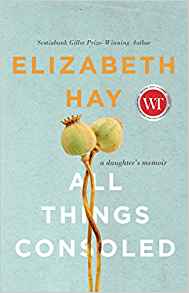
All Things Consoled, reads like a diary of the journey. It felt as if I was in her family with her, and I could see it all as clear as a bell. It is the great joy of my life to have so many experiences, so many connections, and so many travels all taking place within the bounds of my quite elastic imagination. A recent class with Margaret Atwood asked me to consider how to evoke emotions in the reader. Her statement landed like a direct hit. That is the trick of it.
Elizabeth Hay managed to evoke memories of all the irritating moments where you want to scream, but know that would be very unwise. By using her considerable skill to put me in her mother’s kitchen, I was transported back to the fifties when as a young girl, I experienced first hand, the holdover of the depression years, and the need not to waste food. Two characters, named willful and woeful were given little dishes covered in wax paper and then saran wrap before it found its cling, two measly bites that must be saved, less “Willful waste brings woeful want.” In my mother’s case, the sensibility only applied to food, a contradiction we often pointed out. Hay’s mother’s endearing obsession had me thinking back with great affection to my mother’s old pink fridge at our summer cottage on Lake Joseph in Ontario.
As for the father, although they were vastly different kinds of men, there were similarities there too. Punishment, as meted out to children in our time, could be harsh. Micheal Ondaatje in Warlight wrote that to write a memoir is to be an orphan. Surely there are great hurdles. One wants to get close to the truth, but one loathes to tell it. Idealize the whole family and write a rosy tale where all skeletons are swept dutifully under the carpet, does not come off as believable. To reveal all is sometimes too painful for anyone to read. How to get it just right must be the greatest challenge ever. It is not uncommon for some to write more than one memoir, because side stories and different issues keep popping up.
They will keep on coming too because the heart of the story, the telling of it, is a journey. In the case of All Things Consoled, the reader comes away with great respect for the author. She found the right note, and she managed to achieve a balance with her parent’s foibles and her own. We, too, can relate to their struggles and feel compassion for them as the frailty of old age crept in. Memorable characters, evocatively brought to light, makes this a great read.
From Page 233:
“The instinct to make art had abandoned her, but not the instinct to save food. She could not pass the communal fruit bowl in the lobby without her hand reaching out like a raccoon’s for apples and oranges, which she slipped into the basket of her walker and wheeled to her room. We took to calling her the fruit tree, self-grafting, everbearing. Her little fridge groaned with what she salted away. Every few days I emptied it into a canvas bag, assuring her that nothing would go to waste. Then I would stop by the kitchen on my way out of the building and put the food in the garbage and the napkins into the laundry bag and the plates on the counter. I stopped at the famous fruit bowl and returned apples and oranges.”
How this passage makes me anxious! I think of my parents with great affection at Christmas time. We were so lucky to not know real want, a fact my Mom pointed out constantly. Elizabeth Hay helped to console me, for I will always miss them. As we always gave books as gifts, and Boxing Day meant cracking open a great new read, with a personal inscription on the title page, I still have bits of them with me in my library. As for the living room, I have their console tables too.
Still Dreaming
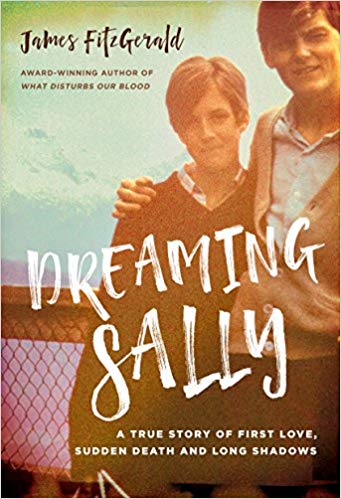
When was the last time you liked a book so much that you read it twice? Dreaming Sally by James Fitzgerald has captivated my imagination. A true story, it outlines the tale of a life cut short, and of the two men who loved and lost, and struggled in the aftermath. By his heavenly powers of description, it is as if the author peeled back the veil, and re-created a lively young woman who seemed beautifully natural and full of fun. Seeing her through the eyes of a teenage male in love with her, but not able to win her heart, gives the story an extra portion of poignancy. Coupling the tale with Sally’s betrothed who also lost her, made me feel for both of them in this love story cut short by death.
The power of the author’s skill made me feel like a mad teenager again, searching the mean streets of the city for the next thrill. I could hear the music, taste the wine, feel the pressures upon us, and fail to understand my parent’s generation all over again. It takes amazing courage to penetrate to the heart of the story, and give over to honest self- examination. The settings, the dialogue, and the story remain vivid and are still creeping into my thoughts by the hour. It is a litmus test of sorts, to see how long the words linger. This book is one I will never forget. How impossible is it to bring the dead back to life? Yet it is Sally’s vitality that leaps from the page. That she was right on the cusp of change, the time when human history made a huge leap, the era where birth control set women free to explore their sexuality, and the time when collectively, the female of the species declared that the old norms of the patriarchy would never do. Many of us can identify with Sally and can imagine how her life would have unfolded. I see all the makings of a matriarch who would have created a fine family. She was about to begin nursing school and would have emerged with an even stronger sense of herself. Romantic, nostalgic and all too real, the book has left me in greater awe of master story-teller James Fitzgerald.
Something Old, Something New
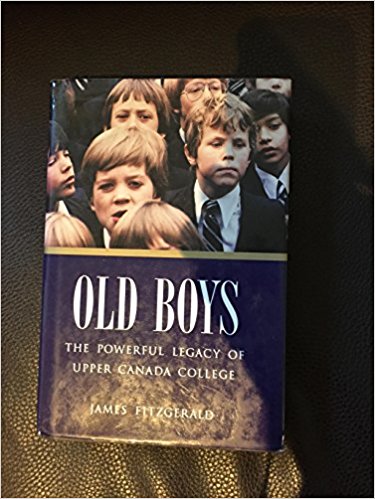
James Fitzgerald has given us a fantastic gift. In compiling stories spanning decades, he has created a national treasure of personal accounts and anecdotes of the men who attended Upper Canada College in Toronto. For those of us, who, like me, had a boyfriend, a father, a grandfather, uncles, cousins and a brother at the school, I gained much insight into a culture that played a significant role in shaping the history of our family. The book describes what a same-sex education has to offer privileged males who run on pure competition. Win or lose, sink or swim: it is a game of Darwin’s social contract brought to the playing fields. What Fitzgerald brought to the project is an almost impossible feat: asking males to describe what they felt about things. Spoken as one who spent years asking the same questions, and for the most part, only ending up with precious few answers, I am in awe of this work.
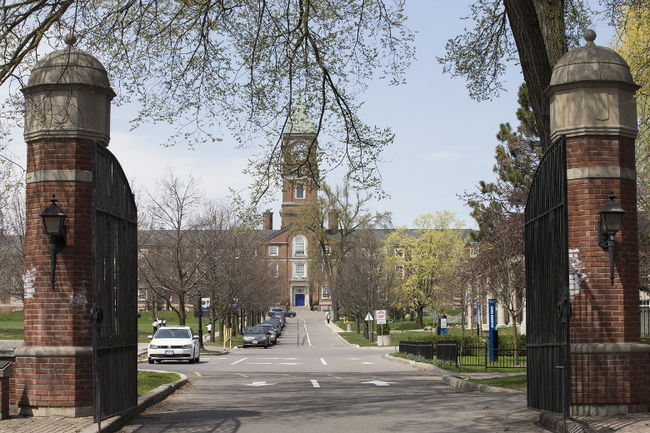
An all-male academy, complete with cadet training and church parades, how they dazzled us in their uniforms. We delighted us to see the Old Boys come out, fathers and grandfathers, all headed to St. Paul’s Cathedral in the springtime. Church was a part of the curriculum, but it seems after reading this book, that something was lost in the translation. Ceaseless, relentless, ruthless bullying went on from faculty to student, to the weakest and most vulnerable among them, the little boys in the prep. It was a gut-wrenching read at times, but I could not put the book down. I barely slept; it was as if I was handcuffed to it. I appreciated the honesty with which these former students described the joys and sorrows of being enrolled at U.C.C. Obviously, a contributor might fear to speak out against a system that favored corporal punishment and lots of it. It would be considered a sign of weakness to many; I can imagine the collective bird this book caused among the old guard, but that is all well and good. Violence foisted from the strong to the weak, from those in authority to those in their charge, should and ought to be discussed because the repercussions can go down through the generations. The stranglehold on one’s psyche can be crushing. I have witnessed casualties. Tribalism can be without mercy; the consequences of which can be hideous. Parts of the book read like a horror story. Since I lived it and saw it close at hand, I know the toll all too well.
No institution, no matter how revered, can afford to be seen only through the prism of nostalgia. I applaud James Fitzgerald, whose family goes all the way back to the beginning of the school, for speaking truth to power. Are we as a society so steeped in materialism, social connections, and avenues of success, that we stand back in silence and watch the warping of men’s souls? If training warriors is the intended goal, then they must be lead by the strongest and wisest of men, true heroes that boys look up to in worship. The sadness I felt on page after page, had to do with opportunities lost. Jesuit education, for instance, seeks to enrich body, soul, and mind. It is a mistake for any colony to be ruled by hanging on to traditions of peoples who have long since assimilated and adapted.
It is my great hope that this book will help many who still feel the sting. My fondest wish is that in the future, the school ponies up, finds great teachers and leaders, pays them well beyond the going rate and develops an accurate model of leadership. To do any less short-changes the future.
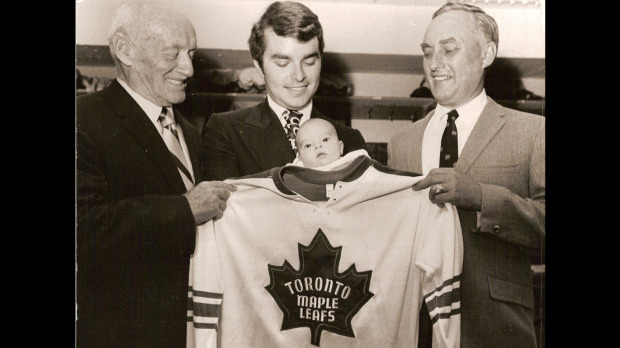 Four generations of old boys from Upper Canada College in the Smythe family.
Remembering Johnny Bower
Remembering Johnny Bower
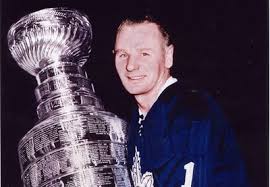
Johnny and Nancy Bower
He was a fixture of my childhood and the recipient of my evening prayers. Kneeling beside the bed, after reciting, “Now I lay me down to sleep,” I was tasked with asking for God’s help with two teams: The Toronto Maple Leafs and The Toronto Marlboroughs. I used to ask God for an extra wish, to watch over our beloved goalie, Johnny Bower.
When children are exposed to their first games, they feel the burden of wins and losses falls exclusively on the shoulders of the goalie. My family was quick to disabuse me of this notion saying a loss was everyone’s fault just as victory belonged to all, even the lowliest of fans like me. I never did stop fearing that it was too much for him to bear. It seemed to me to be the hardest job in the whole wide world. To know the man was to see him deflect my concerns with a humility I never could fathom.
We were in the thick of things in the sixties as hockey was our family business. We were a fiercely competitive bunch who hated losing. We were lucky enough to bear witness to victory, not once but four times over. We were fortunate beyond reason, beyond all measure, to have the best goalie probably of all time. Shots bounced off him right and left. At the games in Maple Leaf Gardens, I kept my eyes fixed on him year after year, suffering when I saw a puck hit him on his bare face. He was tough; he was magnificent, and he was unfailingly kind. Athletes have a duty to children to be a role model and to be worthy of their worship. No one ever exemplified this better than Johnny. He did it with such joy, with such modesty, and with a flair for deflecting flattery.
We held victory parties for those Stanley Cups. We would line up by the front door to receive our beloved Leafs. Friends would admonish my father, and fear for my mother’s carpets, saying, “Why not do this at a hotel?” We packed our house to the rafters. As President of the Toronto Maple Leafs, my father insisted that only our home would do. As the youngest daughter, my place was at the end of the line. We couldn’t wait to shake the hands of our Leafs and tell them how grateful we were. The lion’s share of praise belonged to Johnny. He would shrug when I gushed away. He would pretend he had nothing to do with anything or no idea how it happened. It just did, that’s all.
Over the years, when our paths crossed, he was the same. After my mother died, in 2004, I was out walking one day and saw a sign in front of a sporting goods store saying the 1967 Leafs would be present on Saturday morning. My brother, the late Tom Smythe came with me, and as we stood outside in the line, I was worried about him as he was ill with cancer at the time. One of the employees came out to fetch us saying that the Leafs had requested we be brought inside with them. They were in a small basement signing posters. Johnny came up to say hi to us, as did Red Kelly, Bobby Baun, and Ron Ellis. We sat on the stairs, and as I examined them all, I noticed something about Johnny.
“You don’t have a single scar on your face,” I said.
“That’s because I ducked,” he joked.
“I remember plenty of times when you didn’t. How is it that you have no scars? What is your beauty secret?”
“Cocoa butter. Always after shaving. A coach told me that in Juniors.”
You couldn’t make the man take any credit for anything. I remember him going out of his way to keep engaging my brother in the conversation. I didn’t know a lot of the Leafs that came before the sixties, I didn’t know them personally, but I can’t imagine anyone was a better ambassador for the team than our Johnny. He was the most steadfast, honest, and humble man I have ever had the privilege to know. He will be revered, not just for his full-tilt splits, for all those glove saves, for facing Gordie Howe and all the others greats, night after night, but for who he was most of all. It simply is unfathomable how he could achieve so much without ever becoming proud. Courage paired with sweetness, and the kindest heart the city has known. Oh, how he will be missed.
Johnny, we hardly knew ye.
“Go South to the River.”
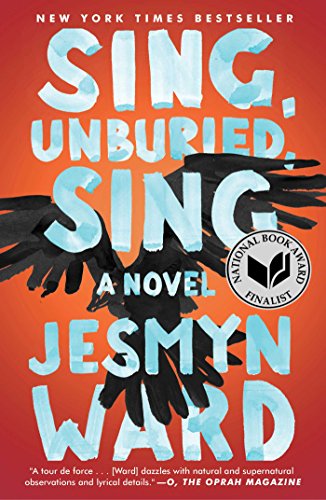

Can we write about characters who are broken? Can we write about mothers who cannot seem to feed or care for their children? How does such a narrative hold the reader’s attention? After being in The Best Food Ever Book Club for the past three decades, I have heard many dissenting opinions about characters who fill the pages of our selections. There have been passionate arguments about the merits of books, and some have been quick to weigh in on the likeability of those whose thoughts will fill our heads as we read. The protagonist must capture our hearts; if everyone around them leaves little to admire, we will pull for the hero to break free. This is how I would describe JoJo, the thirteen-year-old boy on the cusp of manhood in Jesamyn Ward’s, Sing, Unburied, Sing.
As the author won the National Book Award for Salvage the Bones and has now gone on to win another, she brings a hefty amount of literary chops to the challenge. In her recent novel, she describes the difficulties before JoJo which seem nearly insurmountable. If anyone reading this is of the age-old belief that we are all born with the same chance in this great country, I would advise reading Jesmyn Ward. Isn’t it the greatest trick, or achievement, to actually change a reader’s philosophy, or understanding of life, by describing a family in the midst of their world and struggles? Will this allow the reader to see how much smooth sailing they may have had in life compared to someone born deep in the swamps of Mississippi whose ancestors were slaves? Through every page of this book, the reader is forced to accept that some families do not need to pull themselves up by the bootstraps because there have not been any boots for generations. How will this end? That is what kept me up at night caught in the grips of this magical tale.The road-trip story has had a place in my heart since reading Jack Kerouac in my teens. If everyone seems to be rolling along, just barely coping, as soon as they get in the car and attempt to go on a journey, our anxiety begins to increase. In the case of Sing, Unburied, Sing, the destination is a prison. JoJo’s white father is about to be released. His white grandfather will not have anything to do with him, but they plan a visit nevertheless. This knowledge increased his fragile identity, and I wished he was able to stay home with his black grandfather who cared for him.
With all of the families’ frailties, his dysfunctional mother, Leonie stands out above all others. JoJo’s baby sister clings to him by instinct, and it is our hero who looks out for her. Sometimes, as when in the hands of a skilled author, we yearn for the protagonist to turn out to be a fine upstanding man, but feel the deck is stacked against him. What are the odds? What will have to change in his life for this to happen? Of all the suspenseful situations an author can put her characters in, nothing keeps this reader clutching a book more than a baby who needs to be fed. There is no better way to describe a marginalized society than through the eyes of a hungry child.
This book lingered in my mind for weeks. Bits and pieces would come back to me while on walks, or working, or making dinner. It was the mood that would return. There is such a dreamy quality to this work. Ghosts inhabit the characters, as surely as they must remain in those swamps down south. There can never be enough stories of what happened after the slaves were free. Never. When an author can describe the merest remnants of African culture, passed down by the merest of threads, the story begins to inhabit my imagination and dreams.
From Page 174:
“The inside of the store is so cool and the outside air so hot and wet that the windows are fogged up. I can’t see Leonie’s car from inside, only the smeared gray on the glass. The man at the counter got a big brown bushy beard, every hair going every which way on his face, but the rest of him is thin and yellow, even his hair which he’s combed over his head to hide the baldness underneath. It works, too, because his scalp is as yellow as the rest of him, so it’s hard for me to tell where his skin ends and his hair sprouts.”
This is the voice of JoJo relating his impression of the roadside stop.
Ward is at her lyrical best when she writes in the voice of a ghost.
From Page 191:
“Today when Jojo came to Parchman, I woke to the whispering of the white snake, which had dug a nest down into the earth with me so he could speak to me in my ear. So he would curl about my head in the dark and whisper, If you would rise, I can take you across the waters of this world to another. This place binds you. Keep the scale, even if you cannot fly. Go south, to River, to the face of the waters. He will show you. Go south.”
Every family has a story, and every one of them is worth telling. The greatness of the endeavor would have to lie in the chosen word, and in the author’s skill. Jesmyn Ward has achieved all of this by winning the National Book Award for the second time.
A Book to Read Again and Again
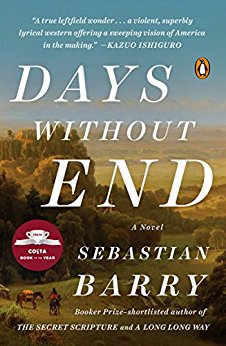
Because I adored his previous novel, The Secret Scripture, I knew I would be in the hands of a master storyteller when I picked up this book. Yet I was surprised and delighted from the first page to realize I was in the hands, not only of a great writer but in one of those rare instances where you know as soon as the character’s voice begins to ring in your ear, that he spoke to the author the same way. Thomas McNulty, an escapee of the great famine, signs up in the 1850’s for the U.S. Army. History will always bear out that Ireland was the greatest national nursery for soldiers, according to the British at least, and then the United States. Right off the boat they were given their marching orders, went off where they were told and made friends with their comrades in arms along the way. It is the friendship between Thomas and the handsome John Cole that moves the story from Wyoming to Tennessee. They face the horrors of war in many different phases and guises, yet they manage to form a bond, an unconventional family unit, but a family nevertheless. It gives the story its anchor and the touching desire to be true to that family, their adopted Sioux daughter that makes the reader feel as if they are crisscrossing time and distance. Lyrical is the term most used to describe this beautiful writing. I would add magical with a slight cringe because I never use that word to describe writing, but in this case, I am forced to make an exception. There is a story that exists that needs to be found, there are characters that sometimes show up and start talking, but if between those two elements another chimerical world emerges, even in all the gore of war, then you have created something that stands apart from everything. It is a book that you do not want to end and must do something to overcome the accompanying sadness at having to put it down. It is a book you may not read too quickly because you know you will feel this way at the end. It is a book you keep on your coffee table or nightstand because you cannot even bear to add it to your groaning shelves, just yet. Barry may even inspire you to look him up so you may learn more about him. If he had a fan club, I would join it. I’ve listened to him read from Days Without End more than once. It is a book for your Christmas list, and one already purchased and sent on to a friend.
From Page 232
“Big train blowing steam and smoke at the depot. It’s like a creature. Something in perpetual explosion. Huge long muscle body on her and four big men punching coal into her boiler. It’s a sight. It’s going to be dragging four carriages east and the say they’ll do good. The light pall of snow hisses on the boiler sheets. Wish I could report well of the third-class wagon but it’s evil cold and damp and me and Winona got to sit in close as cats. Not an inch to move because our fellow passengers thought to bring their whole possessions with them. We even got goats and the mark of goats is stink.”
This is the voice of Thomas who would be on a list if I had ever comprised such a thing, as an all time great character, one I will never forget and one whom I think I know.
Life is very quiet these days at Windy Bay. September on Lake Coeur d’ Alene is often a busy time with boats being pulled from the water, docks going out, and getting the garden ready for winter. The summer people are mostly gone now, and I suppose some would fear a lonely winter ahead. As long as I have a list of books to read, I embrace the season. Although there are more choices to read, as far as the challenge of the short-listed books for the Man Booker Prize is concerned, my vote is cast. The quality and variety of available works is staggering and my hat goes off to everyone who has had the temerity and talent to get this far. Some are in a world apart though, and that is where I would put this master Irish story-teller.

You may listen to him read here: https://www.theguardian.com/books/audio/2017/feb/03/sebastian-barry-on-his-costa-winning-novel-days-without-end-books-podcast
The Zen of Chance
Spring is arriving on Windy Bay and not without drama. The water is high, and docks are floating every which way, untethered and adrift. I have been thinking about the role of chance in our lives and our stories. When do we feel the gentle hand of fate touching our shoulder? What do we do when that happens? Run and hide, or take a few gingerly steps into the unknown?
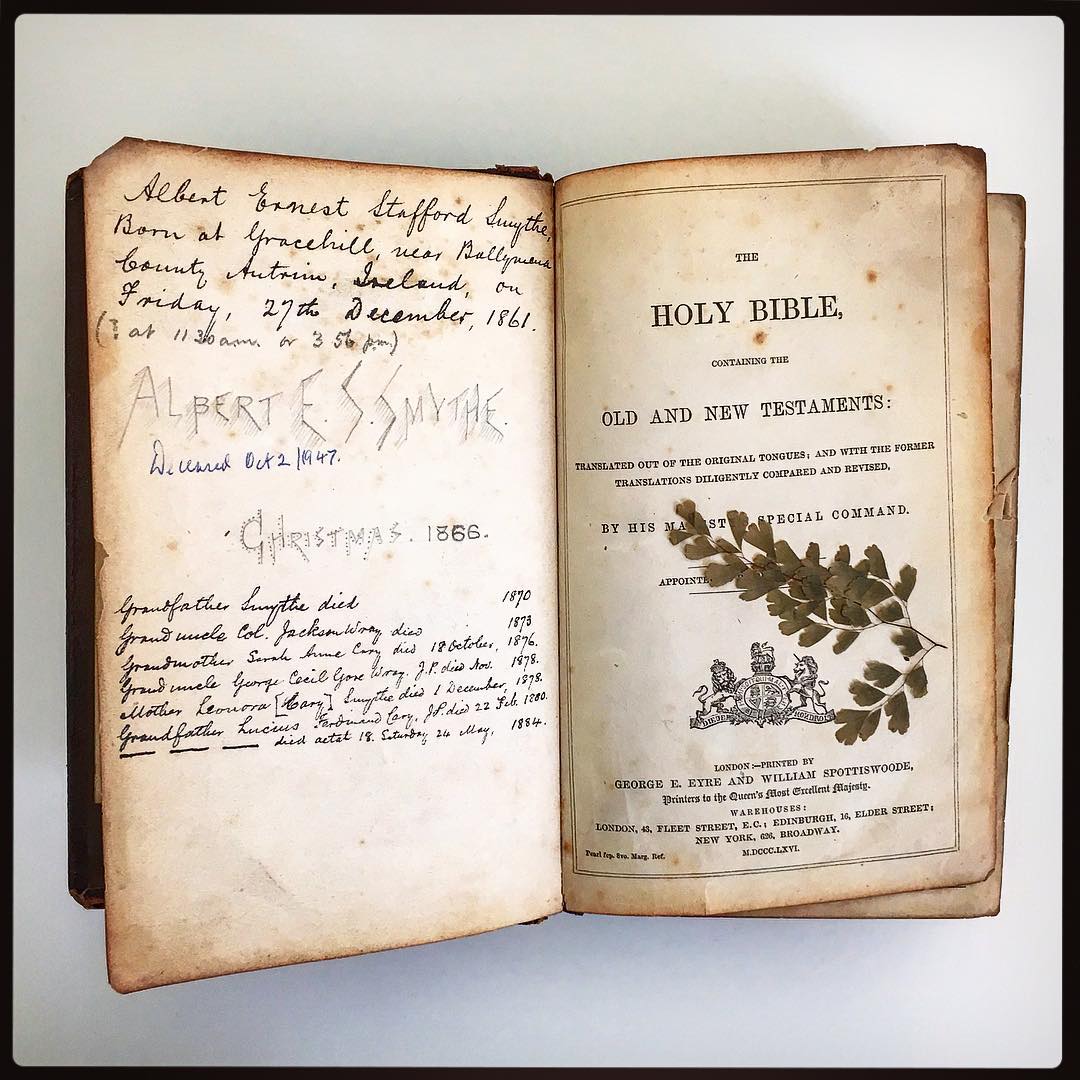
This train of thought began on St. Patrick’s Day when I glanced at an Instagram post from my nephew, Tommy Smythe. He captured the title page of a Bible belonging to his great-great-grandfather who braved the seas and sailed for the new world. His first attempt was foiled. In his own hand, Albert Ernest Stafford Smythe, my great-grandfather wrote these words:
“This Bible is the only possession saved from the shipwreck of E.J.Harland on the 19th of November 1861.”
Hit by a two-ton steamer named Lake Champlain, Captain Smylie went down with his ship; the rest were transferred to the offending vessel and ended up back in Liverpool. This voyage took place when my great-grandfather was a young man of eighteen years of age. He lost his cherished mother the year before. In spite of ending up with nothing to his name, save a Bible, he was not deterred.
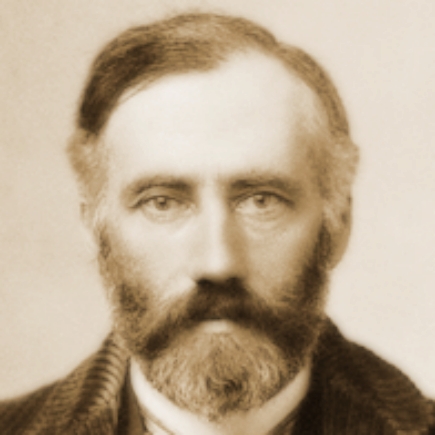 William Q. Judge
On his second voyage, he met a man who was to change his life. On his way back to America from India, William Q. Judge, co-founder of the early Theosophist movement along with H.P. Blavatsky and Henry S. Olcott, had plenty of words of wisdom for his fellow ship-mates. Born in Ireland, April 13, 1851, Judge was now in full understanding of humanity’s great need for a new perspective on both itself and the universe.
Here is Albert E.S. Smythe’s shipboard assessment of the man:
“Judge was the master of ordinary conditions and could get honey out of the merest weed. He walked the decks with those in need of a companion, he played cards, except on Sunday when he drew the line, he played quoits, and he chatted.” The Canadian Theosophist, April 1939.
In our modern viewpoint, the word karma is part of our lives. We often joke about it, misuse the term, or think of it either lightly, or having to do with a sense of just desserts. In the later part of the 1800’s, when the concept was still in need of illuminating, Judge told the story of an Eastern King who had spawned but one son.
“And this son committed a deed, the penalty of which was that he should be killed by a great stone thrown upon him. But it was seen that this would not repair the wrong, nor give the offender the chance to become a better man. The counselors of the king advised that the stone should be broken into smaller pieces and thrown at the son and at his children and grandchildren as they were able to bear it. It was so done, and all were in some sense sufferers, yet none were destroyed.”
The Path 1892. From Sunrise Magazine, December 1996/ January 1997, copyright Theosophical University Press.
Chance. A chance encounter aboard a ship carrying my great grandfather to the new world changed the trajectory of our lives. What if the first ship, the fully rigged E.J. Harland, had not foundered? What if Albert E.S. Smythe had landed in New York, with his Bible and other possessions intact. While I do not recall hearing the tale of the Eastern King, I do know that it was made very clear to all of us that we were to understand one simple teaching: “Yea as you sew, surely do you reap.”
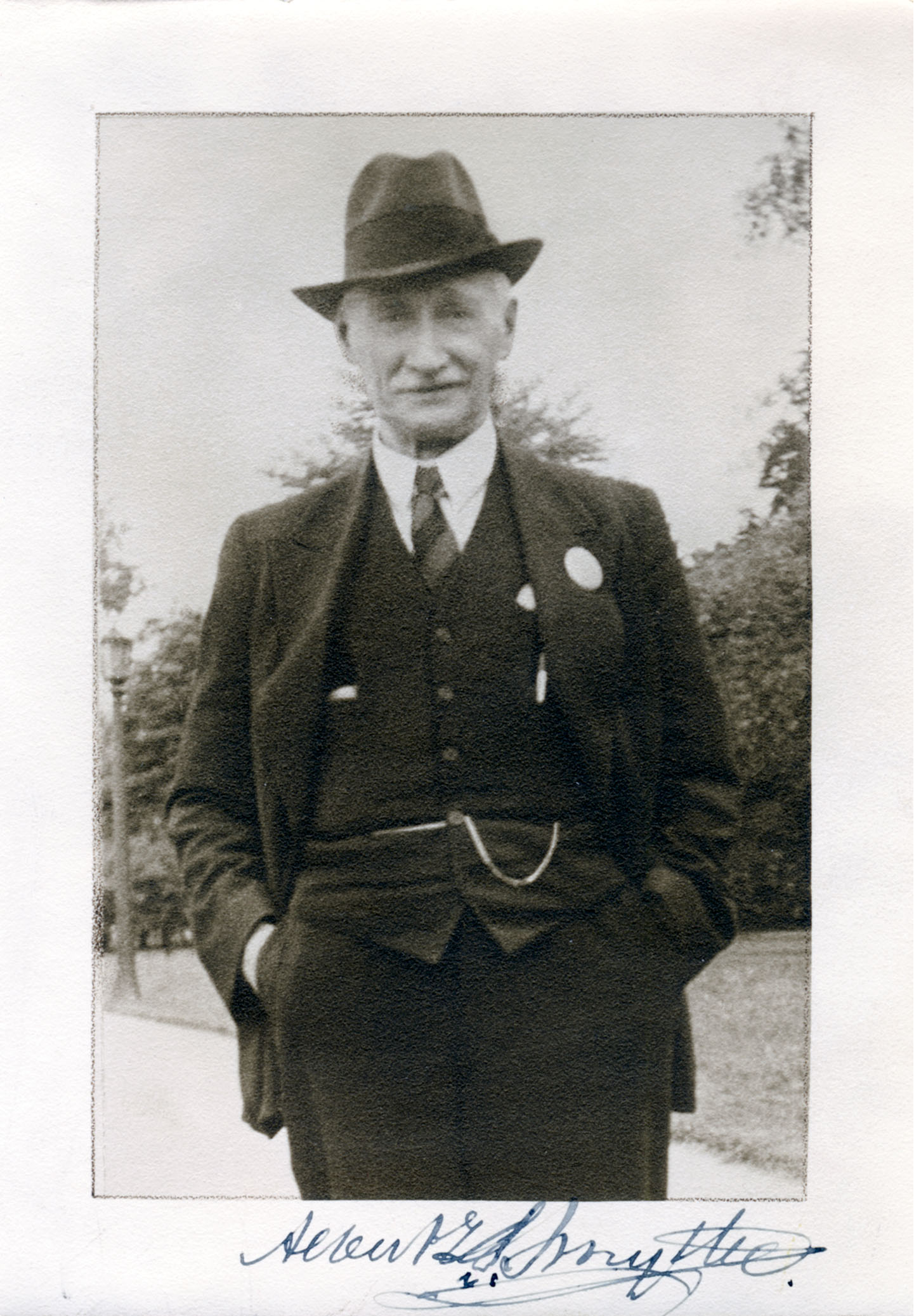
My fate changed for good when I chanced to find a ski lodge in Aspen where I met my future husband. Had I not stopped in to see if there was a vacancy, I certainly would not be where I am today, here on Windy Bay, with docks knocking on the edge of the shore. I’ll always be glad that when chance came knocking, I knew what to do.
The Opposite of Nothing is Something
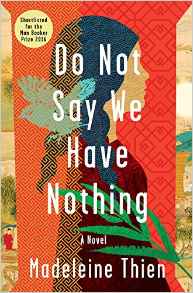
Thien‘s style is intricate and beautiful. She is deft at moving through settings, characters and time. It is a book that can be described, as Annie Lamont put it, written ‘word by word.‘ From the very start, I found myself inwardly gasping at the beauty of her writing.
The book opens with a profound and engaging beginning. “In a single year, my father left us twice. The first time, to end his marriage, and the second, when he took his own life.” Page 3.
From this start, we follow Thien’s journey to understand the events that led to this pass. She is living in Vancouver, in an apartment shared with her mother when we first encounter this thoughtful, cerebral girl. Before long a third person arrives without a coat and carrying a light suitcase. She is a family friend whose history is connected to theirs. What links them together is the fact that both of the fathers were musicians forbidden to practice their craft in the dark years of the Cultural Revolution. If music sustained her father, Marie finds a home in mathematics.
From Page 191:
“In the spring of 2000, after my mother passed away, I gave myself entirely to my studies. The logic of mathematics-its methods of induction and deduction, its power to describe abstract shapes that have no counterpart in the real world- sustained me. I moved out of the apartment that my mother had been renting ever since she and Ba first came to Canada, and in which I had grown up. Desperate to leave it behind, I cobbled together every penny I had and bought a dilapidated apartment on Alexander Street. The windows looked straight out into the port of Vancouver and, at night, the endless arrivals and departures of multi-coloured shipping containers, what they held, what they divulged, comforted me.
I kept my parents’ papers in the bedroom closet and a Cantor taped to the wall: ‘The essence of mathematics lies in its freedom.’”
This picture finds an easy grace in my imagination. The link between Shanghai and the western ports of North America, where we now receive goods too staggering in size to even contemplate from a nation that was once brought to its knees is both beautiful and sad. That is the tone of the work; it hit the right note for winter reading. Every once in a great while, we pick up a book that deserves to be read twice. Some sentences are so profound that the reader needs to stop and puzzle through them. Sometimes it means putting the book down and returning to awaiting tasks with the thoughts presented rattling around begging for more time.
From Page 419:
“I know that throughout my life I have struggled to forgive my father. Now, as I get older, I wish most of all that he had been able to find a way to forgive himself. In the end, I believe these pages and the Book of Records return to the persistence of this desire: to know the times in which we are alive. To keep the record that must be kept, and also, finally, to let it go. That’s what I would tell my father. To have faith that, one day, someone else will keep the record.”
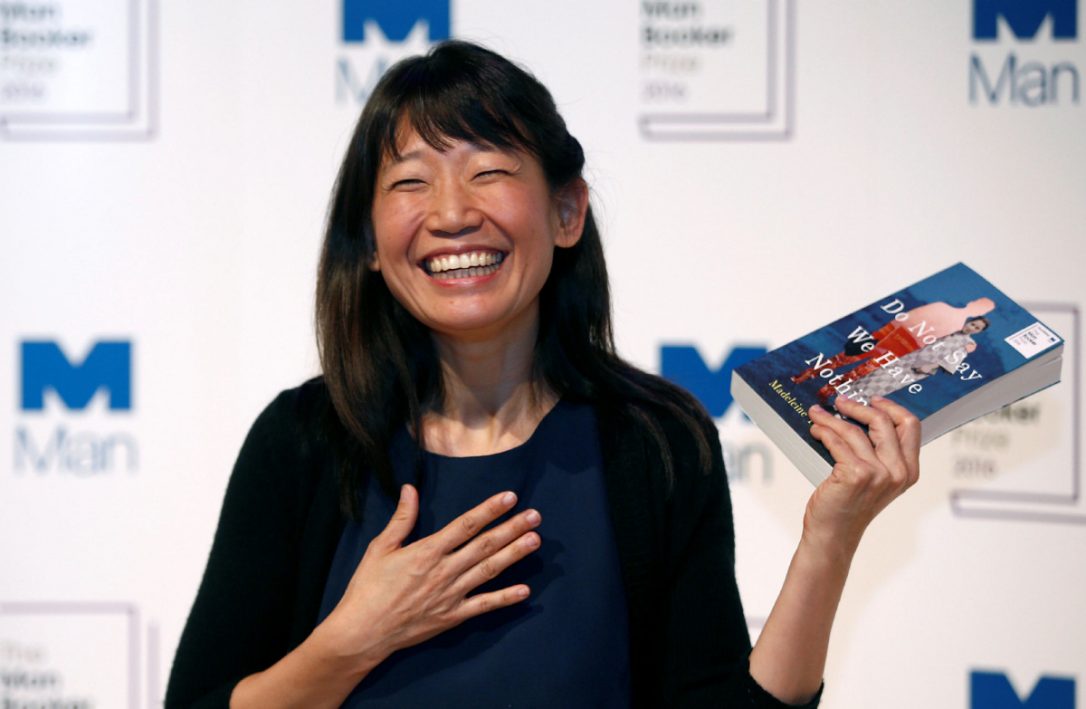
Ideally, a great novel gives us a new understanding, either of times and events or, in the best possible scenario, of the pages of our own story. Madeline Thien’s work carries the power to do this. Could it be possible that I feel as if I am a better person for having read Do Not Say We Have Nothing? I hope so. For God knows, there is much work to be done.