Showing posts with label Canada. Show all posts
Thursday, December 13, 2018
A Noun and a Verb
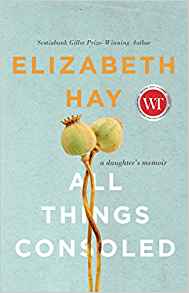
To examine Elizabeth Hay's wonderful book called All Things Consoled is to gaze at the nature of the word itself. Anyone facing grief, or dealing with the difficulties of aging parents, or struggling with the reconciliation of old beefs, and the nature of letting go, will understand that grief is massively challenging. Caring friends may ask us how we are progressing. We will always come up blank. We can try to find peace, to achieve closure, to move on in our lives, but just when we feel we are making some headway, the past circles back, and there we are crying in the car when a sad song comes on the radio. We don't get over things. At least, that is my experience. As I learned on the long canoe trips of my youth, the pack you portage gets a little lighter every day. That best describes my progress or lack thereof.
All Things Consoled, reads like a diary of the journey. It felt as if I was in her family with her, and I could see it all as clear as a bell. It is the great joy of my life to have so many experiences, so many connections, and so many travels all taking place within the bounds of my quite elastic imagination. A recent class with Margaret Atwood asked me to consider how to evoke emotions in the reader. Her statement landed like a direct hit. That is the trick of it.
Elizabeth Hay managed to evoke memories of all the irritating moments where you want to scream, but know that would be very unwise. By using her considerable skill to put me in her mother's kitchen, I was transported back to the fifties when as a young girl, I experienced first hand, the holdover of the depression years, and the need not to waste food. Two characters, named willful and woeful were given little dishes covered in wax paper and then saran wrap before it found its cling, two measly bites that must be saved, less “Willful waste brings woeful want.” In my mother's case, the sensibility only applied to food, a contradiction we often pointed out. Hay's mother's endearing obsession had me thinking back with great affection to my mother's old pink fridge at our summer cottage on Lake Joseph in Ontario.
As for the father, although they were vastly different kinds of men, there were similarities there too. Punishment, as meted out to children in our time, could be harsh. Micheal Ondaatje in Warlight wrote that to write a memoir is to be an orphan. Surely there are great hurdles. One wants to get close to the truth, but one loathes to tell it. Idealize the whole family and write a rosy tale where all skeletons are swept dutifully under the carpet, does not come off as believable. To reveal all is sometimes too painful for anyone to read. How to get it just right must be the greatest challenge ever. It is not uncommon for some to write more than one memoir, because side stories and different issues keep popping up.
They will keep on coming too because the heart of the story, the telling of it, is a journey. In the case of All Things Consoled, the reader comes away with great respect for the author. She found the right note, and she managed to achieve a balance with her parent's foibles and her own. We, too, can relate to their struggles and feel compassion for them as the frailty of old age crept in. Memorable characters, evocatively brought to light, makes this a great read.
From Page 233:
“The instinct to make art had abandoned her, but not the instinct to save food. She could not pass the communal fruit bowl in the lobby without her hand reaching out like a raccoon's for apples and oranges, which she slipped into the basket of her walker and wheeled to her room. We took to calling her the fruit tree, self-grafting, everbearing. Her little fridge groaned with what she salted away. Every few days I emptied it into a canvas bag, assuring her that nothing would go to waste. Then I would stop by the kitchen on my way out of the building and put the food in the garbage and the napkins into the laundry bag and the plates on the counter. I stopped at the famous fruit bowl and returned apples and oranges.”
How this passage makes me anxious! I think of my parents with great affection at Christmas time. We were so lucky to not know real want, a fact my Mom pointed out constantly. Elizabeth Hay helped to console me, for I will always miss them. As we always gave books as gifts, and Boxing Day meant cracking open a great new read, with a personal inscription on the title page, I still have bits of them with me in my library. As for the living room, I have their console tables too.
Thursday, November 15, 2018
Still Dreaming
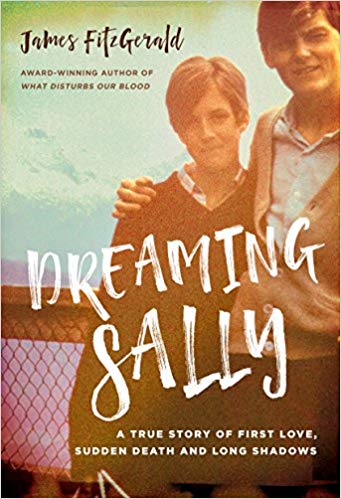
When was the last time you liked a book so much that you read it twice? Dreaming Sally by James Fitzgerald has captivated my imagination. A true story, it outlines the tale of a life cut short, and of the two men who loved and lost, and struggled in the aftermath. By his heavenly powers of description, it is as if the author peeled back the veil, and re-created a lively young woman who seemed beautifully natural and full of fun. Seeing her through the eyes of a teenage male in love with her, but not able to win her heart, gives the story an extra portion of poignancy. Coupling the tale with Sally’s betrothed who also lost her, made me feel for both of them in this love story cut short by death.
The power of the author’s skill made me feel like a mad teenager again, searching the mean streets of the city for the next thrill. I could hear the music, taste the wine, feel the pressures upon us, and fail to understand my parent’s generation all over again. It takes amazing courage to penetrate to the heart of the story, and give over to honest self- examination. The settings, the dialogue, and the story remain vivid and are still creeping into my thoughts by the hour. It is a litmus test of sorts, to see how long the words linger. This book is one I will never forget. How impossible is it to bring the dead back to life? Yet it is Sally’s vitality that leaps from the page. That she was right on the cusp of change, the time when human history made a huge leap, the era where birth control set women free to explore their sexuality, and the time when collectively, the female of the species declared that the old norms of the patriarchy would never do. Many of us can identify with Sally and can imagine how her life would have unfolded. I see all the makings of a matriarch who would have created a fine family. She was about to begin nursing school and would have emerged with an even stronger sense of herself. Romantic, nostalgic and all too real, the book has left me in greater awe of master story-teller James Fitzgerald.
Tuesday, January 2, 2018
Remembering Johnny Bower
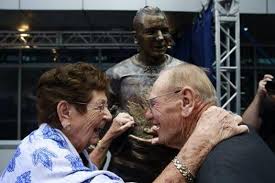
Johnny and Nancy Bower
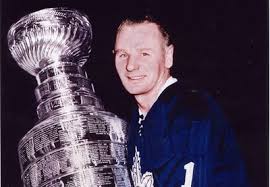
He was a fixture of my childhood and the recipient of my evening prayers. Kneeling beside the bed, after reciting, “Now I lay me down to sleep,” I was tasked with asking for God’s help with two teams: The Toronto Maple Leafs and The Toronto Marlboroughs. I used to ask God for an extra wish, to watch over our beloved goalie, Johnny Bower.
When children are exposed to their first games, they feel the burden of wins and losses falls exclusively on the shoulders of the goalie. My family was quick to disabuse me of this notion saying a loss was everyone’s fault just as victory belonged to all, even the lowliest of fans like me. I never did stop fearing that it was too much for him to bear. It seemed to me to be the hardest job in the whole wide world. To know the man was to see him deflect my concerns with a humility I never could fathom.
We were in the thick of things in the sixties as hockey was our family business. We were a fiercely competitive bunch who hated losing. We were lucky enough to bear witness to victory, not once but four times over. We were fortunate beyond reason, beyond all measure, to have the best goalie probably of all time. Shots bounced off him right and left. At the games in Maple Leaf Gardens, I kept my eyes fixed on him year after year, suffering when I saw a puck hit him on his bare face. He was tough; he was magnificent, and he was unfailingly kind. Athletes have a duty to children to be a role model and to be worthy of their worship. No one ever exemplified this better than Johnny. He did it with such joy, with such modesty, and with a flair for deflecting flattery.
We held victory parties for those Stanley Cups. We would line up by the front door to receive our beloved Leafs. Friends would admonish my father, and fear for my mother’s carpets, saying, “Why not do this at a hotel?” We packed our house to the rafters. As President of the Toronto Maple Leafs, my father insisted that only our home would do. As the youngest daughter, my place was at the end of the line. We couldn’t wait to shake the hands of our Leafs and tell them how grateful we were. The lion’s share of praise belonged to Johnny. He would shrug when I gushed away. He would pretend he had nothing to do with anything or no idea how it happened. It just did, that’s all.
Over the years, when our paths crossed, he was the same. After my mother died, in 2004, I was out walking one day and saw a sign in front of a sporting goods store saying the 1967 Leafs would be present on Saturday morning. My brother, the late Tom Smythe came with me, and as we stood outside in the line, I was worried about him as he was ill with cancer at the time. One of the employees came out to fetch us saying that the Leafs had requested we be brought inside with them. They were in a small basement signing posters. Johnny came up to say hi to us, as did Red Kelly, Bobby Baun, and Ron Ellis. We sat on the stairs, and as I examined them all, I noticed something about Johnny.
“You don’t have a single scar on your face,” I said.
“That’s because I ducked,” he joked.
“I remember plenty of times when you didn’t. How is it that you have no scars? What is your beauty secret?”
“Cocoa butter. Always after shaving. A coach told me that in Juniors.”
You couldn’t make the man take any credit for anything. I remember him going out of his way to keep engaging my brother in the conversation. I didn’t know a lot of the Leafs that came before the sixties, I didn’t know them personally, but I can’t imagine anyone was a better ambassador for the team than our Johnny. He was the most steadfast, honest, and humble man I have ever had the privilege to know. He will be revered, not just for his full-tilt splits, for all those glove saves, for facing Gordie Howe and all the others greats, night after night, but for who he was most of all. It simply is unfathomable how he could achieve so much without ever becoming proud. Courage paired with sweetness, and the kindest heart the city has known. Oh, how he will be missed.
Johnny, we hardly knew ye.
Sunday, February 2, 2014
Brilliant Hockey, Epic Figure Skating and Beautiful Writing
What does a perfect, white
sheet of ice mean to you?
It means two things to me:
victory and defeat.
In my early years, we were
at the rink in the winter day in and day out. Figure skating was an
obscure and disciplined world. It did not capture vast numbers of
fans until later. The old National Hockey League consisted of six
teams, from six great cities: Toronto, Montreal, Chicago, New York
Detroit and Boston.
We knew other countries
played hockey, but we also knew that we were nuts about the game in
Canada. It was a common thread running through all of us, coast to
coast. When the games were broadcast on the radio, people across the
frozen north would huddle around and listen to the impassioned,
unbridled enthusiasm of a famous broadcaster named Foster Hewit.
During the second world war, soldiers were able to listen from the
battlefield. It became a part of our emerging identity, this love of
the game. Somewhere along the line, it became our game, as synonymous
with Canada as the maple leaf itself.
We knew that Sweden and
Russia were passionate about it too. We knew from the Winter
Olympics. When it came to Figure Skating, we were up against great
competitors who studied ballet and Figure Skating in tandem. Pairs
like the Protopopovs were simply breath taking and unbeatable. They
challenged us and tested us daily. As far as hockey was concerned, we
could not send our best players to the Olympics as they played in the
National Hockey League. Yet we had to know how we would match up. We
wanted a true test. An effort began to arrange a series where our
best could match with theirs. It was a long and complicated effort.
When hearts softened and culture exchanges were made, including
bringing the sublime Bolshoi ballet to Toronto, we got our big test
at last.
At first, the Russians
dominated and beat us soundly. Some said it would be a joke and our
humiliation would be without end. The players, all stars in their own
right, had not played together as a team. The Russian team work
had years in the making. We rallied and tied the series. We were up
to a do or die situation with the game tied up. I could feel the
pressure, and the tension build to the breaking point. Children were
let out of school to go home and watch the game. We were on the edge
of our seats, on our knees, and even our dogs whimpered. We could not
breathe. Along came a magic moment. Paul Henderson of the Toronto
Maple Leafs got the puck and tapped it in the net. The whole nation of
Canada roared!
Two men, driving trucks on
and ice road stopped to listen to that moment. They were each heading
in opposite directions. With the final moments so nerve wracking,
they could not even keep their feet on the gas. So they stopped.
Along with the rest of Canada, they held their breath. With that
goal, they ran out of their trucks, on to the ice and embraced each
other. Total strangers and tough men, they hugged each other and
cried. Then they came to their senses got back in their trucks and
carried on. None of us would ever be the same.
A few years later, the
United States went up against those great players and felt the same
thrill known as the miracle on ice. In both instances, the countries
were united in rooting for their team. Hockey is often described as a
battle. It is a tough and often brutal game, but it is brilliant and
magnificent too. The finest players are swift, brave and in
possession of a fierce intelligence.
The athletes make their
mark. The sports writers, the announcers, and the broadcasters, make
the events unforgettable.Will we ever forget Dick Button? Foster
Hewitt is immortal. As we go into winter, I count on the writers up
in the press box to put me right in the rink. I want to share the
thrills with others. I want to see who we are up against. I love to
see countries with smaller populations and fewer dollars to spend,
present a formidable challenge. I love to see the Russians come out in
their red jackets. It brings tears to my eyes because we have a
common bond. In every category, I am in awe of their artistry and
effort.
I understand why people want
to go south in winter. I know they get tired of shoveling their
driveways. I can grasp how spirits lag in the dark days. The first
blades were made of wood. We went out into the snow in sweaters. We
covered up in fur robes and had fun out on the ice. Then came the
silver and we learned to carve. That sound, along with puck hitting
the boards goes back to my infancy. I saw Petra Burka land the first
triple jump in competition. She went on to become world champion, and
she was from our club where her mother taught us. How could I not be a
devoted fan for life? Moms, Dads, Zamboni drivers, and people all
over the world, get ready. The Olympics are coming to Sochi, and we
will be hosted by masters of the ice. I wait with bated breath.
Subscribe to:
Posts (Atom)