Showing posts with label writing. Show all posts
Thursday, December 13, 2018
A Noun and a Verb
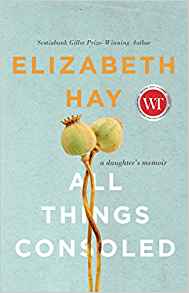
To examine Elizabeth Hay's wonderful book called All Things Consoled is to gaze at the nature of the word itself. Anyone facing grief, or dealing with the difficulties of aging parents, or struggling with the reconciliation of old beefs, and the nature of letting go, will understand that grief is massively challenging. Caring friends may ask us how we are progressing. We will always come up blank. We can try to find peace, to achieve closure, to move on in our lives, but just when we feel we are making some headway, the past circles back, and there we are crying in the car when a sad song comes on the radio. We don't get over things. At least, that is my experience. As I learned on the long canoe trips of my youth, the pack you portage gets a little lighter every day. That best describes my progress or lack thereof.
All Things Consoled, reads like a diary of the journey. It felt as if I was in her family with her, and I could see it all as clear as a bell. It is the great joy of my life to have so many experiences, so many connections, and so many travels all taking place within the bounds of my quite elastic imagination. A recent class with Margaret Atwood asked me to consider how to evoke emotions in the reader. Her statement landed like a direct hit. That is the trick of it.
Elizabeth Hay managed to evoke memories of all the irritating moments where you want to scream, but know that would be very unwise. By using her considerable skill to put me in her mother's kitchen, I was transported back to the fifties when as a young girl, I experienced first hand, the holdover of the depression years, and the need not to waste food. Two characters, named willful and woeful were given little dishes covered in wax paper and then saran wrap before it found its cling, two measly bites that must be saved, less “Willful waste brings woeful want.” In my mother's case, the sensibility only applied to food, a contradiction we often pointed out. Hay's mother's endearing obsession had me thinking back with great affection to my mother's old pink fridge at our summer cottage on Lake Joseph in Ontario.
As for the father, although they were vastly different kinds of men, there were similarities there too. Punishment, as meted out to children in our time, could be harsh. Micheal Ondaatje in Warlight wrote that to write a memoir is to be an orphan. Surely there are great hurdles. One wants to get close to the truth, but one loathes to tell it. Idealize the whole family and write a rosy tale where all skeletons are swept dutifully under the carpet, does not come off as believable. To reveal all is sometimes too painful for anyone to read. How to get it just right must be the greatest challenge ever. It is not uncommon for some to write more than one memoir, because side stories and different issues keep popping up.
They will keep on coming too because the heart of the story, the telling of it, is a journey. In the case of All Things Consoled, the reader comes away with great respect for the author. She found the right note, and she managed to achieve a balance with her parent's foibles and her own. We, too, can relate to their struggles and feel compassion for them as the frailty of old age crept in. Memorable characters, evocatively brought to light, makes this a great read.
From Page 233:
“The instinct to make art had abandoned her, but not the instinct to save food. She could not pass the communal fruit bowl in the lobby without her hand reaching out like a raccoon's for apples and oranges, which she slipped into the basket of her walker and wheeled to her room. We took to calling her the fruit tree, self-grafting, everbearing. Her little fridge groaned with what she salted away. Every few days I emptied it into a canvas bag, assuring her that nothing would go to waste. Then I would stop by the kitchen on my way out of the building and put the food in the garbage and the napkins into the laundry bag and the plates on the counter. I stopped at the famous fruit bowl and returned apples and oranges.”
How this passage makes me anxious! I think of my parents with great affection at Christmas time. We were so lucky to not know real want, a fact my Mom pointed out constantly. Elizabeth Hay helped to console me, for I will always miss them. As we always gave books as gifts, and Boxing Day meant cracking open a great new read, with a personal inscription on the title page, I still have bits of them with me in my library. As for the living room, I have their console tables too.
Tuesday, November 11, 2014
In Flanders Fields

The famous poem written by Lieutenant Colonel John McCrae, penned as a memorial for his slain friend, Alexis Helmer, pictured above, captures the essence of sacrifice. The chilling poem grew to symbolize World War One itself. School children in Canada were tasked with memorizing it, and reciting it at the eleventh hour, on the eleventh day, of the eleventh month. This year, as we remember the fallen, we know that they are all together now; there are no living survivors of what is often called, 'The Great War.'
It was supposed to be the war to end all wars. As my great grandfather was a committed pacifist, we can only surmise how difficult it must have been for him to see his only son go off to war. Fortunately, we have access to the letter he wrote expressing his thoughts:
The World Office,
Tuesday 1st February, 1916
My dear boy, I suppose you find it hard to think of yourself twenty-one years ago, but the dear little chap who used to love me so much and put his arms around my neck, and climb up on my knee, and play ball and do all the other little things which you won't think anything of until you have children of your own, are all on my mind. Well dearie, you are a man now and your own master as I have always tried to have you be. I may not have done as well by you as I hoped, but you are all I could wish in the main things, clean, truthful, brave and generous. I think you will have enough regard for the old days to keep these things in your heart all your life.
You are going on a high quest now, not for yourself but for all the world. I have never bothered you much with religion, but I want you to feel that you are at all times in the care of the Master and that He will be with you in times of difficulty or danger. Even though you stand in the shadow of death you need fear no evil for He will be with you if your heart is turned to Him.
The war has interfered with many plans I had for you. You are going to England but not as I expected. I do not know what another year may bring, but we are all in the hands of the Eternal. I hope you won't think of this as a sermon or a screed. It is just a loving word from your old Daddy to wish you all the best things in the world, and to kiss you goodbye as you go away and leave all the old times behind forever. Don't forget, no one will ever love you better than I do. It makes me all the sorrier that I have such a poor way of showing it.
God bless you dear, now and always.
Love, my dear boy, Your loving Daddy
By the grace of God my grandfather lived and came home to raise a family. A recent book, released in Canada last week, depicted many of his experiences in the war. He was at all four major battles: Ypres, the Somme, Passchendale, and Vimy Ridge. He was also a fly boy, and in this book, I saw a photo of him in his leather coat, leather hat and goggles. At one point, his plane was shot down and even though he was wounded, he managed to land it in an obliging field. He said it fell in circles as a leaf comes down from a tree.
His gunner tapped him on the shoulder and asked, "What is going to happen?"
He said, "You and I have had a lot of arguments about religion Wardsy, and in about forty seconds, we will find out who is right."
Conn Smythe in flight gear.
Mercifully, they managed to land and as they scrambled out of the plane, they saw a man waiving to them frantically. Feeling they were about to be rescued, they headed for him only to learn to their horror that it was a German. He pointed his gun at my grandfather's chest and pulled the trigger, twice at point blank range. Luckily, the soldier missed and my grandfather later told us that it was the force of his wrath and will that somehow steered the bullets into his coat, passing him by completely. After this brush with death, he was taken prisoner and later escaped. Eventually captured, he had to spend the rest of the war in solitary confinement.
To read of all these tales so many years later, to learn of the horrific carnage, and see photo's of his old friends and teammates from home, many of whom did not return, makes me so cognizant of the merest thread separating us all from life and death.
We have not lost sight of all the brave Canadians who died so far away from home. We pause in silence this Armistice Day, at eleven am on 11/11/ to remember all the fallen on all sides, and pray, as always, for a real, lasting and enduring peace.
Between the crosses, row on row,
That mark our place: and in the sky
The larks still bravely singing fly
Scarce heard amid the guns below.
We are the dead: Short days ago,
We lived, felt dawn, saw sunset glow,
Loved and were loved: and now we lie
In Flanders fields!
Take up our quarrel with the foe
To you, from failing hands, we throw
The torch: be yours to hold it high
If ye break faith with us who die,
We shall not sleep, though poppies grow
In Flanders fields
Wednesday, October 29, 2014
Bucket List for Writers
![]() |
| Bucket List |
Do you remember the 2007 movie "The Bucket
List" starring Jack Nicholson and Morgan Freeman? The title is derived
from the slang term "kick the bucket" meaning "to die." In silent Western movies a character would fall down kicking over a bucket. That was the signal to the audience that he had died. Many
people have written their personal bucket list of things to do before they die
just like in the movie.
In recent weeks in the United States a young woman,
Brittany Maynard, has made news by writing her personal bucket
list. She has an untreatable, painful brain tumor and death is in
the immediate future. She has moved to the state of Oregon where the right to die
act is legally practiced. She has selected November 1 as her date of death. In the past
few days, she checked off the last thing on her bucket list.... a trip to the
Grand Canyon in Arizona. I wish her well in her journey.
A bucket list is different than a to-do list. The
latter has things on it like: buy soap, return library books, buy gas, and
register for writing class. It is meant as a reminder of tasks you wish to do
today. A bucket list is a reminder of things to fulfill but on a grander scale
(play at Carnegie Hall versus practice recital pieces). It includes goals
you wish to accomplish, dreams you realistically want to fulfill and life
experiences you desire before you die.
Writing a bucket list forces you to think what you
really want. Some items may be materialistic but most are adventures or goals
you set for yourself. It is a plan for your future. It is a blueprint for where
you want to go and what you want to do. It gives clarity and focus to your life.
To me, it makes me think about what I will work hard to make happen, places and
people I want to see and challenges I want to tackle. It is realistic.
I know I will never be a ballerina (I am five feet
tall and in the later part my 60th decade) but this doesn't diminish my desire
to enjoy number four on my list: another performance of Russia's Bolshoi
Ballet. The first time I saw them perform, I cried I enjoyed it so much. The BL solidifies my number three desire to
spend two weeks in Paris. I do not want to play the
piano at Carnegie Hall but I do want increase significantly my playing skills
to better understand and enjoy music. These are legitimate items on my bucket
list.
We, as writers, can benefit from a Bucket List aimed at our writing.
Some goals for me to put down may be to finish the novel I started five years
ago; send more query letters to different agents regarding my newly finished
nonfiction book; learn to spin wool so I can write an article for the weaving
magazine; refine what public libraries I want to visit to do research for a new
idea I have for a different nonfiction book; and clean out my writing files!
Thinking about what I want to accomplish versus what I have to accomplish gets
me excited and motivated to check things off my BLW (Bucket List, Writing).
Your BLW is probably entirely different than mine. Yours may include
finding a writers' retreat for the summer of 2016, winning a writing contest
and trying your hand at Goth novels. Who knows? You know. You know what your
heart is beating toward and where your brain is heading. Write down a BLW,frame
it and put it on the wall in front of your computer. Put on the teakettle or
coffee pot and get busy.
![]() |
| Bern, Switzerland |
![]() |
| Granddaughters |
![]() |
| Tulips in Holland |
Thursday, August 14, 2014
For Robin
The year was 1976. The nightclub in Aspen where I worked had booked a two week gig with comedians from The Comedy Store. Steve Martin had been our guest a few weeks prior and I thought whoever was sent from L.A. could not come within a hundred miles of his rising star. Since I would be hearing the show night after night, I thought I would be in for a big snooze.
On the night I met
Robin Williams, I arrived at the club early and checked in with my
friend who worked in the office. He said the guys were setting up
backstage. Remembering I had left my black, high-heeled boots there
earlier in the day, I thought I could sneak in unobserved and
retrieve them. I pushed the curtain aside and reached down to pick
them up, almost bumping in to a handsome young man wearing a long
sleeved tee shirt, suspenders and khakis.
“I'm sorry to
disturb you. I just came to get my boots.” I put out my hand and
introduced myself.
“I'm Robin,” he
replied. “I was going to use those in my act.” He took one boot
from my hand and put it on like and evening glove. As soon as he
started making jokes, I thought the week might be looking up after
all.
Being that I was
the lowly coatroom girl, I was free to watch the show. I stood in the
back when he took the stage introducing himself as “Russia's only
comedian.” After the show, we all gathered for our one free drink,
sponsored by the owner, and then went out on the town after that.
Word spread like wildfire and the crowds grew larger every night.
Robin came back in
the summer to open for a band that ended up canceling at the last
minute. It was like a classic movie scene where we learned the
business would fold if we couldn't come up with some wild scheme to
fill the place. The idea of asking Robin to do the whole show was
absolutely preposterous, but knowing we would all be out of work if
he failed to save the day, we persuaded him to say yes. He didn't
know if he would be able to do it, to go from fifteen minutes of
comedy to performing a one man show. He wasn't sure if he had enough
material from what seemed to stem from a stream of consciousness. We
offered all the help and encouragement we could. He asked me to come
onstage with him, doing a few bits when he lost his train of thought,
or came to a dead end. While I watched for those times when he might
need a new direction, I realized that he had a far greater wealth of
material than we knew. He had characters and voices, he had skits,
and bits, like one of his favorites, “Attack of the killer chairs.”
Observing him made me stand back in wonder. He killed it, night after
night. He had the quickest wit I had ever encountered in my life. His
gift was staggering, yet he bore it with humility. Some nights he
would stay “on” for an hour or two after the show, but once done
it would all close, just as if someone drew a curtain across his
eyes. Then he would be quiet.
We all knew that
someone would discover him soon and it was only a matter of time
before he would go on to far greater heights. The privilege of
watching his career unfold, seeing him live up to his full potential,
thrilled me over and over. I knew his offstage persona, his sweet,
shy manner, his dazzling intellect, his moral compass, his
gentlemanly sensibility and his heart. I can honestly say that I
truly admired the man, and had a fondness for him that never wavered.
Under what lucky star was I born that I would bump into someone like
him?
We saw him when he
came through Spokane in the spring of 2013, to do a retrospective
show with David Steinberg. In the car on the way home, I expressed a
thousand concerns and worries about Robin. That night while cheerful,
generous and friendly, I sensed an overall exhaustion setting in that
troubled me.
The news of his
death and the manner of his demise shocked us all. He will be deeply
and profoundly missed. Sometimes we forget that we are mortal.
Perhaps genius at that level, comes along once in a hundred years. He
inspired me, every step of the way. I have never stopped believing in
the power of the imagination. He reminded me of a young colt that
prances and dances as he is let out of the stall. A thoroughbred with
the bloodlines of a true champion, Robin took comedy in a new
direction. He knew we had more in common than we realized. His peers
spoke of his generosity. He touched an entire generation of children.
We don't have the
answers. We don't even know the right questions. After watching The
Birdcage last night, I felt guilty for laughing. My ribcage hurts
today, and my face aches. All those years ago in Aspen, one of our friends remembered the old English nursery rhyme and recited it as we gathered for our free drink. It was not familiar to most, but it was to me, as it was to him. These are the last lines:
- "All the birds of the air
- fell a-sighing and a-sobbing,
- when they heard the bell toll
- for poor Cock Robin."
Friday, May 23, 2014
Monday, May 19, 2014
Writing The Italian Way?
Writing North Idaho is sad to announce that Kathy Cooney Dobbs is retiring her position as a permanent contributor to this blog. Kathy is a woman of not only many writing talents, but also a woman whose interests keep her days jam packed with fun activities. She has a list of "BFFs" that would circle the world. With a keen, critical eye, records Kathy's many adventures via her camera, and her writing, including many nature pictures from around northern Idaho. We wish Kathy the best in her adventures. Please follow Kathy at her blog: 2lanehighway.blogspot.com. Kathy always closes as shall we, "Toodle loo for now."
![]() |
| Lucca, Italy beginning of tour of Tuscany |
JENNIFER ROVA
My husband and I travel a lot both in the United States and abroad. I began traveling as a child on family vacations that took us all over the Western, Midwest and many Eastern states. Bob and I continued the tradition by taking driving vacations with our children each year. At this time I have logged all fifty states and 32 foreign countries. This is not meant to be bragging but a set up for the paragraphs to follow.
People who know I am a writer think I have vaults of
travel diaries, journals, stories based on actual experiences or fictionalized
accounts of events that took place on any one of these trips. They think I have
summarized salient points of traveling and have handouts ready to give people
who want to know hiking trails in the highlands of Scotland, what to do in
Vienna, how to avoid long lines at the Louvre or how to make lefsa the true
Norwegian way.
I have none of these, unfortunately, but for plausible reasons.
I never have been a diary person. I do not like to put down my personal
thoughts about my life for others read 10 years or a century later. I remember
what I want to remember and that is good enough. I travel to see landscapes
with views different from Hayden Lake outside my door with the Bitterroot
section of the Rocky Mountains in the background.
I travel to smell different things like lavender growing in the fields of Provence, France. I want to observe people and how they go about their every day business of life and what clothes they wear when they work and play. Are they the same as what I would see in the United States? Standing where Michelangelo stood in Carrara, Italy selecting the marble for his statue of David, looking at the Avon River near Shakespeare’s home or standing where the Bastille ended Marie Antoinette’s life brings a thrill to me. I am actually standing in front of the cathedral Monet painted dozens of times and where Joan of Arc was burned at the stake. Walking the battlefield of Custer's Last Stand helps me picture what happened that day. I walk in history’s footsteps and thus understand it better!
I do not travel to shop. I do not need to say, “Oh,
this old thing? Why I bought this wool, hand made, embroidered Hungarian jacket
on one our trips to Budapest. By they way, darhling, that’s pronounced Buda
Pesht.” I don’t travel to race through the Hermitage in St. Petersburg in order
to find a bar and have several drinks with my newest friends. I want to walk slowly in
the Montmartre section of Paris where Van Gogh, Manet and Lautrec walked and
talked together. I revel in seeing the room where the Continental Congress formed our United States of America.
![]() |
| San Gimignano, Italy (Tuscany region) |
![]() |
| THE tower in Pisa |
Travel writing does not have to be a daily diary of
what you saw and ate. It needn’t be adventure turned moralistic stories like Conrad’s
Heart of Darkness.
It could be explorative adventure, writing about
nature, outdoor sports (what a soccer stadium in Liverpool feels, smells and
sounds like, or a story on how difficult is it to blow a vuvuzela, that annoyingly
loud horn heard at African soccer games, or an Australian didgeridoo). It could take form from a picture of my ancestors’ stave house of
worship near Lillehammer, Norway, or how the state park in South Dakota has
changed over the years from my childhood in the 50’s to the modern buildings
but both with the same views of Mt. Rushmore and its four presidents.
On the schedule for later in the year is a trip through the hillside
towns and city streets, museums and cathedrals of Tuscany. The last time I
gazed at the statue of David in Florence was 45 years ago. I do not think he has changed or bought clothes since then but this time I will try to capture
the awe of others viewing this magnificent marble monolith. While
sipping a glass of red Chianti vino at a village center café in Siena, I will make use
of a mini tape recorder to later be able to bring back the sounds of the
Italians in every day life.
Thinking about how I could enrich any of my writing
has led me to purchase a medium sized, easy to carry journal for this trip. It
will be interesting to find out what a difference memories written down
will tender to my future attempts at writing of any kind.
Ciao!
Monday, April 21, 2014
Fare Thee Well, Coldwater Creek
Every company has a
story. If it is a good one, people will be attracted to it.
The story of
Coldwater Creek has come to the
last page. Bankrupt and closing its doors, many analysts cite
reasons, but for those of us who think of it as a living breathing
entity, this is a sorry state of affairs.
Started in a ski
condo, in 1984 by Denis and Ann Pence, it had an unlikely beginning. After
moving to Sandpoint and saying goodbye to their corporate jobs, they
decided to launch a catalog business. Their first attempts when,
described by Dennis, were funny. A whale watching instrument which
ostensibly one could play on the coast and illicit a response,
yielded but one sale. It was later returned. One day a package arrived,
unbidden. A stunning silver buckle with a native theme became the
product that launched the company. Ann came up with the name as they
walked along the shores of Lake Pend Oreille. A former copywriter,
she played a huge part in creating a national brand selling women's fashion over three channels: catalog, web and retail. It was not long before they became a Fortune 500 company.
It was 1999 when I
answered an add in the paper and began a new chapter in my life. As a
hands on Mom at home, my previous place of employment had been a ski
lodge and nightclub in Aspen, Co, back in the late seventies. After agonizing over my resume, I
went down to the call center and sat in the lobby for about twenty
minutes. I wanted to get a sense of the people and know the feel of
the place before I tossed my hat in the ring. A woman walked by with
a pail. Thinking it looked a bit odd, she responded to my quizzical
expression by telling me that she was going out to feed the birds.
That was the clincher for me. The fact that she took the time to
speak to me, a stranger sitting there as if waiting for something.
Feeling that it would be a friendly, welcoming place, I took the
leap. Initially hired to be on the 'phones as part of the rank and
file, we were told in training class that if we could write a letter,
we should apply for the web team. While the title sounded daunting,
we were informed that live chat was just around the corner and they
needed people to man it. 1999 was the year America discovered online
shopping. Oh, how we had to coax people to pull out their credit cards.
Business went through the roof and the intrepid little web team
worked at breakneck speed. We would be up to five written
conversations going on simultaneously, while answering email. Not
only did we manage, this small team of fourteen people won an award
for best Internet Customer Service and we were written up in the Wall
Street Journal.
After that, I went
on to become a Product Trainer. Teaching agents in both Coeur d'
Alene, and by video teleconference, West Virginia, we enjoyed
continued success. Something strange began to happen when the
customers would call in: they began professing their love for us. We were given
an ethic of customer service and we were empowered to make our
customers happy. If they complained about shipping costs we were
allowed to erase it from their account. We took any return; we bent
over backwards to make sure that they were pleased with their
purchases. We knew their figure problems, their life problems, their
weight gains and losses. We were allowed to talk, off script, within
reason of course, but we enjoyed those relationships. Through it all,
it seemed unlikely that such an endeavor could spring from a small
town like Sandpoint.
The company grew
and expanded. Denis Pence had the essence of a true entrepreneure. He
tried new things. He scrapped ideas that didn't work. He knew every
product. He would come and talk to us, meet with all his agents, and
hear their concerns. We didn't sit in those meetings mute with fear:
we spoke up and told him what were hearing from customers. They
wanted long tops, we told him. The wanted to be comfortable. They
wanted to get out of sweat pants, look nice, but still be able to
move and bend. They had a hard time finding pants that fit. We all
got on the 'phones at Christmas. Men would call beseeching us for
help. We gave them a set of steps. Go to her closet. Find something
she wears all the time. Get a tape measure and give us the
statistics. It used to make me laugh to hear them go to their toolbox
and get out the metal one used on fix it projects and carpentry, but
they were so happy to have a plan in place.
Training manuals, letters, live chat, and interpreting the copy, all fell under my jurisdiction. It became a job of both writing and speaking. Defining the brand became an interesting challenge, especially as it grew and changed. I relished the chance to be writing, in whatever form, and I thanked my lucky stars that my love of fashion and writing had come together in this form. Having gone to a girl's school and a women's college, the best part of punching a time clock every day for me, came in the form of a work place full of kind and caring women. We had nice guys there too, but they were greatly outnumbered.
Any company is so
much more than the products on the shelves, or the ebb and flow of
dollars out and in. It is a complex set of relationships. It is also a story. The
garments in my closet still hold the Coldwater Creek label. For most
people, it will be nothing but a memory soon. Yet it will be something
different for me. A lesson learned, a collective of people of good
faith, and a never ending sense of gratitude for all the great souls I met
along the way.
Friday, March 7, 2014
The Ides of March and March Madness
So many interesting dates fill the calendar this month. Ash Wednesday, the start of Lent was March 5, March 15 we mark the Ides of March, on the 17th is St. Patrick's Day, two days later, the Feast of St. Joseph, when the swallows return to Mission San Juan Capistrano. And of course, March Madness when for two weeks college basketball (NCAA Men's Division) is the all the rage and talk of the nation (Go, Zags!) . Not to overlook Daylight Savings Time March 9, and the first day of Spring March 20.
It seems to me March makes a perfect month for a writing marathon. As writers, we all need to be inspired, motivated, and find material for what we want to write about. Stories and characters could be developed around Julius Caesar and the Roman Empire, the wee leprechaun and Irish folklore, or a study about the miracle of the 'Swallows' that takes place each St. Joseph's day at the most famous mission in California.
In his book, the Daily Writer, Fred White provides mediations to help writers, and has chosen several helpful themes for March, including Establishing The Journal-Writing Habit, Observing the Details, and Exacting the Unusual From Everyday Experiences .
His mediation for March 14 , Writing To Preserve History was thoughtful when he offers for further reflection:
Writing is essential to preserving history. Not only that, the quality of the writing - its precision, its depth of coverage - determines the quality of the historical record. If you plan to write a historical event , you must be faithful to the historical record and correct inaccuracies in the existing record.
It's still early March, I encourage all you writers, pick a theme and start writing !
Friday, January 24, 2014
The Beauty of North Idaho & Local Authors
What comes to mind when you think of north Idaho? Is it fishing at Dawson Lake in Boundary County? Snow skiing at Schweitzer? Sailing on Lake Pend Oreille, or perhaps paddling the deep blue waters of Lake Coeur d Alene? Is it the pristine beauty of Priest River, and picking huckleberries in late summer? Maybe the rich heritage of the Coeur d Alene Indians or historic Cataldo Mission, the oldest standing building in Idaho - also known as the Mission of the Sacred Heart, founded by Jesuit priest, Father Pierre-Jean De Smet in 1848.
How about the Route of the Hiawatha Trail, the old Milwaukee Railroad line making its way through Wallace , now a popular mountain bicycle trail popular with locals and tourists, or Camp Sweyolakan, one of the oldest resident camps in the United States with nearly 300 wooded acres on the shores on Mica Bay, with one of the largest fleets of classic war canoes [for more about Sweyolakan, see my stories "Two if by Sea" IDAHO magazine, September 2012 and "Paddles Aweigh - Around the Lake in Ten Days" IDAHO magazine, December 2013].
North Idaho has long been touted for its beautiful rivers and lakes, rich forested land and abundant wild life - elk, deer, moose; Red Tail hawks and the majestic Eagle soaring across a smog free sky.
I have travelled in Mexico, throughout Europe, western Canada and many parts of the United States, and still find north Idaho to be among the most magnificent landscapes I've ever seen. What some might call, 'God's Country'. But there is another hallmark here, too. Something worth noting. It is a fertile environment for the creative mind, the daydreamer, the artist, the musician, the writer.
While there isn't space here to recognize every author from north Idaho and their books, several come to mind:
Marianne Love. After reading her, Pocket Girdles and other Confessions of a Northwest Farm Girl, an uproarious collection of autobiographical stories about rural life in the northwest, I decided I wanted to write memoir, to tell stories like she did, in a humorous, heartfelt way. It was after attending one of Marianne's writing workshops, and her encouraging words about blogging I started my own blog, 2 lane highway( http://2lanehighway.blogspot.com). Marianne remains one of my favorite writers.
Nancy Owens Barnes. Moose for Breakfast Outdoor Poems & Essays published by Rushing River Press gives picturesque view of north Idaho living through Nancy's colorful words and prose. Nancy is winner of the 2008 Zola Award for Poetry and was 2007 Jessie Cameron Alison Writer of the Year. Her book South to Alaska From the Heartland of America to the Heart of a Dream of one man's dream of living in Alaska fulfilled after he builds a 47 ft. boat in his Arkansas backyard begins a journey through a watery world he knows little about, to a world he cannot forget.
Elizabeth S. Brinton. "We landed with no thoughts of religious freedom in mind." So begins, My American Eden / Mary Dyer, Martyr for Freedom. Chris Peck , editor, the Commercial Appeal writes, She captures with grace the gripping human story of a remarkable woman of faith who dared to challenge the dark side of an emerging America. Brinton uses her grasp of history and politics to help us better understand what happens when the line between government might and what is right is blurred.
Phyllis Horne. The Carnival Girl - One Woman's Journey Through the Carnival Life tells how the author ran away from home at 14 and became a carnie - a carnival worker at the Pike in Long Beach, California. Hers is a story of brushes with the law, broken relationships and family trials until she eventually overcame those challenges and eventually owned her own business in Idaho.
Ana Parker Goodwin. A former psychotherapist and lecturer turned writer, Anna writes a fictional account of Dr. Faythe Bradington , a Clinical Psychologist, shocked to learn that an ex-client is suing her for implanting false memories of childhood sexual abuse in Justice Forbidden - A Dr. Faythe Bradington And L.P. Sanborn Novel. Ana is also co-author of renowned textbook on Sand Play Therapy.
D. Faye Higbee. The Dog Paw Chronicles/The Autobiography Of A Writer chronicles the authors life in short story form, with the addition of canine philosophy by Red the Dog.
Michael Marsden. Author of several books, including The House in Harrison and The Black Dog Bed and Breakfast, Michael is a long time member of Idaho Writers League. His favorite quote is one from E.L. Doctorow, "Good writing is supposed to evoke sensation in the reader, not the fact that it's raining, but the feeling of being rained upon."
Not just published book authors, but scriptwriters, magazine writers, copyrighters, and bloggers as well. Mary Jane Honegger recently won first place at the Sandpoint Film Festival for her screenplay, Root Bound , a short film of how complications arise when a young professional denies his Idaho roots when he is hired by a national television show.
Jenny Leo and Jennifer Rova are contributors to Writing North Idaho, and currently working on a novel.
As writers we have a tendency to only look to the J.K. Rowlings, Steven Kings and other renowned authors far away for inspiration, motivation and instruction, when local authors very near can often provide the same right where we live, and write
* Note: All book titles mentioned in this blog can be purchased on Amazon
Friday, November 22, 2013
Excellent Advice for Writers and Runners
![]() |
| Angela White |
November 8, 2013 by fitfunmom (read posts on 11/18/13 and 11/20/13 for previous posts on this subject
(Who has time for creative post titles during NaNoWriMo? Not me!) Novel word count at start of day 8: 13,040.
In week one, I learned lots of lessons from National Novel Writing Month. Here in week two I’ve learned plenty more (continuing the list):
7. You make time for what’s important to you. Do I have three free hours a day to write? No, I generally do not. But can I cut out watching (as much) television? Yes. Can I steal half an hour to write in my car while I wait to pick up my daughter from gymnastics? Yes. Can I steal another hour to write on a park bench while my youngest plays at the park across the street from her sisters’ tennis lessons? Yes. Can I throw a 15-minute meal in the crock pot on low and save 30 minutes cooking dinner later? Yes. Voilà ! Three hours.
8. Procrastination never feels as good as hitting your word count for the day. All things I have done to procrastinate writing: uploaded family photos and created our family holiday card; paid bills; sorted laundry; loaded the dishwasher; written a blog post (ahem). Did all of those need to be done? Well, yes, at some point. They’re certainly productive. But did they need to come before writing that day? No. It’s okay to be flexible (and sometimes guilt is a good motivator) but it feels a million times better to knock out the writing first and reward yourself with other things later. (I’m not sure the privilege of doing laundry and loading the dishwasher is a “reward” but you know what I mean!)
9. You will lose track of time. That is a good thing. You know you’re in the “writing zone” when you look up at the clock and realize an hour has passed when you could swear it only had been five minutes. I have to set alarms (I’m talking multiple alarms: stove, cellphone) to remember to pick up my kids at school on time. You might even lose days. One day it was Halloween and the next day it was November 8. True story.
10. You will lose sleep. That is not a good thing. Even if you don’t stay up late writing (but you will), your brain will churn with thoughts of plot lines. You’ll dream about (not) hitting your word counts, and wake up as tired as if you hadn’t slept at all. Coffee will be your friend. Don’t be surprised if, about a week in, you finally crash and sleep extra hard one night, and yet wake up with an odd sort of sleep hangover, your body’s way of saying, “Oh, so that’s what sleep is! I want more!”
11. Do yourself a big favor and leave a cliffhanger at the end of the day. What do I mean by cliffhanger? Leave yourself a clear jumping-off point for the next day. Taking a precious few extra minutes to outline the next piece of the plot will save you several agonizing minutes of writer’s block the next day. Write that one scene today of course, but leave yourself an unfinished thread as a starting point for tomorrow’s writing. You could even stop writing in the middle of a
(Hahahaha…. I crack myself up. Forgive me. It’s the sleep deprivation.)
UPDATE on Angela's NaNoWritMo writing as on 11/20/13
Thanks, Angela, for some true-to-life experiences that can teach all of us lessons on how to handle a busy schedule and find time to write.
xo, Mom
Wednesday, November 20, 2013
Lessons from NaNoWriMo
This is the second of three posts from Angela White, blogger, mother, marathon writer (NaNoWriMo) and marathon runner. Number one in this series was posted on 11/18/13.
![]() |
| Angela White in new racing clothes |
Lessons from NaNoWriMo
November 6, 2013 by fitfunmom
National Novel Writing Month Word Count as of midday, day 6: 10,584 words. I’m on track, people! I sat in front of the fireplace today and wrote for three hours. Every day I think I’ll take less time or write more words overall than the day before, but that’s pretty much how long it takes me every single day to crank out the necessary 1,667 words.
Having completed one-fifth of the National Novel Writing Month challenge of writing 50,000 words, I feel pre-eminently qualified (ha!) to write about what NaNoWriMo has taught me so far.
1. With writing just as with exercise, it’s a lot more fun to knock it out in the morning than to put it off until the end of the day. Mind you, that’s not saying it’s any easier to do the work then, just that it’s less pressure and more rewarding to complete it early in the day.
2. The words that flow the fastest are the ones that come from your own experience. You always hear the advice to “write what you know” and now I know why. I simply have to trust that I have a unique experience and a unique perspective to offer.
3. While I’m on the topic of inspirational advice, let’s go with “a journey of a thousand miles begins with one step.” True for the beginning runner, true for the beginning writer. Do not fear the blank page.
4. You know those photos that circulate every once in a while — the ones that show what you think you look like when you run (a graceful Olympian) and what you really look like when you run (a flailing maniac)? That’s how I feel as I’m writing. I feel like a poser, wannabe writer who is sure to be found out as the flailing maniac she really is. But then I remind myself of lesson #3 above. Repeat to self: “a journey of a thousand miles begins with one step.” Everyone has to start somewhere. I wouldn’t fault a beginning runner for not having perfect form at the start of her running journey. Why would I expect to be able to write perfect prose right out of the gate?
5. As a writer it’s hard to “show and not tell.” I tend toward very concise writing and speech, and my first instinct is to say, for example: “She worried what would come next” instead of “She hunched her shoulders and furrowed her brow in nervous anticipation.” When I worked as a lawyer, one seasoned paralegal offered me some advice on how to explain legal concepts to a client: “Write like you’re explaining the law to your grandmother.” I need to write for my grandmother. Set the scene. Describe the smells. Paint the characters. Don’t assume the reader sees any of what you see in your head.
6. Find your motivation. I know why I’m doing this, this mammoth marathon writing project. I’ve always wanted to try my hand at writing a novel and now is as good a time as any to do it. But that’s the big picture motivation. I find that the little picture motivation, for me, is the ability to log my word count for the day and see that blue progress line turn green when I’ve hit 1,667 for the day. It shouldn’t surprise me. After all, I log every mile that I swim, bike or run. Of course I take pleasure in logging every word written!
Subscribe to:
Posts (Atom)


