Showing posts with label vocabulary. Show all posts

Monday, May 7, 2012

Latin Alive !


Plures of lacum audimus quod utom utidie adveho ex Latin
Many of the words we hear and use daily come from Latin

Latin est a key ut English
Latin is a key to English

The first Latin I remember  hearing , (and speaking) was  when I was a  young girl attending daily and Sunday Mass  at St. Rose of Lima Catholic church  in Maywood, California when the Priest  would often  say during the course of the Liturgy, Dominus Vobiscum (The Lord be with you), and Altar Boys responeded, Et Cum Spiritu tuo (And also with you).   Then , the priest again, Oremus (Let us pray).

At that time, prior to Vatican II , Missals  were always printed with the Order of the Mass in Latin on one page, and in English on the opposite page.
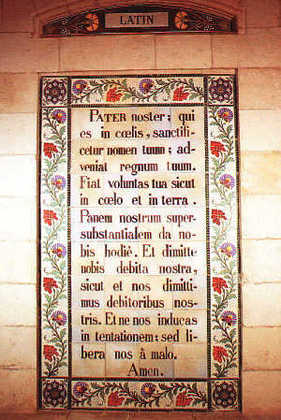
                                                           

My next experience with Latin was when I entered  Bell High School ,  and Mrs. Gerard taught that ancient language to  Freshman students who were only half interested in what she was teaching.   After all, Latin was considered a dead language.  Looking through memories eye, I remember Mrs. Gerard as a pleasant white haired lady who  seemed to love what she was doing, and delighted in showing her students slide pictures of her trips to Rome, and sharing her love of Latin.   She would periodically stop  her slide presentation to try to stump one of us when she asked a student at random  to name the building, place, object in Latin.   Let’s see.   First Declension or second Declension ?

Oh, how I wish I would have paid better attention !  Enough so to earn an A or B instead of a C.

What I do recall , and still recognize is how much of our English vocabulary  and Latin words have in common, especially in abbreviated form.   Exempli gratia:

A.D. Anno Domini  - in the year of our Lord
A.M. ante meridiem  -  morning (before midday)
P.M. post meridiem  - afternoon
B.A. Baccalaureus Artium  - Bachelor of Arts
M.A. Magister Artium—Master of Arts
Ph.D. Philosophie Doctor—Doctor of Philosophy
N.B. nota bene—note well
P.S. post scriptum—written afterthought
e.g. exempli gratia—for example
Pro tem. Pro tempore—temporarily, for the time
And my favorite, so well expressed by Yul Brynner in his role as King of Siam,
etc.  Et cetera—and other things

 Familiar Latin phrases :
Persona non grata—an unacceptable (or unwelcome ) person
Verbatim ac literatim—word for word  and letter for letter
Pro bono publico  - for the pubic good
Vice versa—changed and turned; turned about

State Mottoes:
Ditat Deus—God enriches (Arizona)
Regnant populi—The people rule (Arkansas)
Esto perpetua—May it be everlasting (Idaho)
Excelsior—Loftier (New York)
Dirigo—I direct  (Maine)
Montani semper liberi  - Mountaineers are always free  ( West Virginia)

Latin phrases are used in the Constitution of the United States:
i.e. Section 3 , dealing with officers of the United States pro tempore , means for the time; In Section 9, dealing with powers forbidden to the United States—the privilege of the writ of habeas corpus, making it mandatory that an accused person be brought to court to be told the reason for his or her detention.

The names of all our months come from Latin.  As do the planets, astrological signs, medical terms, musical terms and legal terms.

In her book , Latin Made Simple,  (Doubleday Made Simple, copyright 1992),  Rhonda Hendricks gives an overview of Latin literature writing  it is usually divided into six periods: The Early Period  prior to 80 B.C., The Golden Age—lasting from 80 B.C. until A.D. 14,  The Silver Age; The fourth period called The Patristic Age ran from the late second century through the fifth century. The major writers included the Church Fathers (patres). During this period the Romance languages were developing from local dialects of Latin. The fifth period , called the Medieval Period ran from the sixth through the fourteenth centuries. The sixth and final period  runs from the fifteenth century until the present day. It is called the Modern Period.

The author also writes, Although a classical language, Latin is vital and living—a pillar of our language, our culture, our civilization. Latin is a thread that connects us with our own history; if it were to snap, we would lose our relationship to that past.

Mrs. Gerard would be pleased . As writers, and lover of words , we should be pleased too, to know this language of  history continues to provide meaning and value in our literary life.


        ** For more Latin Phrases visit      http://www.tameri.com/write/coollatin.html    


Wednesday, February 1, 2012

Amazing Greats: Stalking the Super Superlative

My recent post on copywriting reminded me that one of the biggest challenges facing copywriters (especially those who specialize in marketing and promotion) is to come up with fresh, original ways to say that something is good. After all, how many times can I say a product is great, fantastic, or new-and-improved before readers start tuning me out?

I was in high school when I first realized the inadequacy of the word nice. The very common description "Jane Doe is nice" could mean anything or nothing, and generally meant only that Jane Doe exhibited no overtly objectionable qualities, at least in the opinion of the speaker. Faint praise at best. Nice told me next to nothing about Jane. What exactly made her nice? Was she friendly? Polite? Smart? Funny? Thoughtful? Kind to animals? Skilled at games? Without really being aware of it, I started a little personal boycott of nice, substituting more precise descriptions. I didn't always succeed--after all, nice is an overused word for a reason--but the attempt did boost my vocabulary a bit.

Recalling this former aversion to nice, I consulted my friend Webster to discover what the word actually means. Imagine my surprise to find that nice comes from a Middle English word meaning foolish, wanton, silly, or simple. Huh? Only further down the list do we find the more common modern take on nice: pleasing, agreeable, appropriate, fitting, well-bred, virtuous, respectable, polite, and kind. In my opinion, any of those terms goes a lot further in describing a person than nice does.

What is your favorite positive descriptor of choice? Are you fond of awesome? Did you know that awe comes from the Greek achos, meaning "pain," and is "an emotion variously combining dread, veneration, or wonder"? If you're using it to describe a hamburger, you might want to rethink your word choice.

Another adjective currently repeated ad nauseum is amazing (apparently most effective if you draw out the second syllable: ah-MAAAAAAY-zing!). Knowing that this word descends from the Middle English amasen, meaning bewilder, confuse, or perplex, "to show or cause astonishment," do you still want to tell your kid every day, "You're amazing!"? (You might, but you should at least understand what it is that you're saying!)

Of course we all know that language changes over time, and Middle English definitions don't necessarily apply to current usage. My point is to encourage you to be precise in your descriptions--to choose descriptive words carefully and not always fall back on the current well-worn favorite. Keep a list of appealing descriptions you run across in your reading, and refer to it if you get stuck. Think carefully about word choices and soon you'll be an awesome writer who gets amazing results! And what could be nicer than that?

Monday, September 12, 2011

Words We Choose

The moving commemorations of the disaster of the bombing of the World Trade Centers, the Pentagon and the crash of United Airlines flight 93 in Pennsylvania played out on television yesterday brought back vivid memories of the horror we saw unfolding that terrible day. What will children, not yet born, write 30 years from now about the terrorist acts carried out on 9/11/2001? Will they be able to retell stories of families directly affected by these acts of terror? Will they be able to discern our disgust and fears? Will they understand the rebirth of patriotism that followed? How will they know these things?

Our duty as writers is to write down facts or tell a true story so truthfully and with such erudite choice of words that the reader, who may know nothing about the event, can sense our aching hearts, our anger, disgust, shock, fear, patriotism and incomprehension at what occurred. While writing we need to examine exactly what happened, research the hows and whys, and understand what we want to say when we write. We should think of our potential audience and write in ways that convey the feelings as well as the facts of a particular incident. We need to recreate in the reader’s mind the events as they unfolded, people’s reaction to them at the time and what impact this incident left on our consciousness.

Thesauri are helpful to find the right words; they can tell us synonyms for disgust such as abhor, loathe, and abominate. Do we really mean to write that the actions of the terrorists made us despise or abhor those responsible or do we mean to say that we disliked them or found them intolerable? These words carry slightly different impacts from each other although all are listed in a thesaurus as a synonym for ‘disgust.’ Did I dislike the terrorists? No, I abhorred them! Were their actions intolerable? No, they were repugnant, vile, foul.

Choosing the correct word should tell a future reader exactly what Americans felt during 9/11 or ten years later. The words should tell the readers the awe we all felt when the first person landed on the moon. Did we watch with pleasure, with wonderment, with admiration or with disbelief? Exactly what did we feel? How did we feel and act when the Berlin Wall went down or the polio vaccine was first given? How are people in the future going to know exactly how things were unless we choose our words carefully? The retelling of an event or an experience is sometimes the easy part. The hard part is determining words that elicit the exact feeling or picture we are trying to recreate.

THINGS TO DO TODAY

1. Walk the dog.

2. Make coffee.

3. Enter Writing North Idaho's BRILLIANT BEGINNINGS contest (see details in upper left corner of this page.)

4. Write!